Pressure Performance of FRP Water Tanks: Testing Standards and Engineering Practice
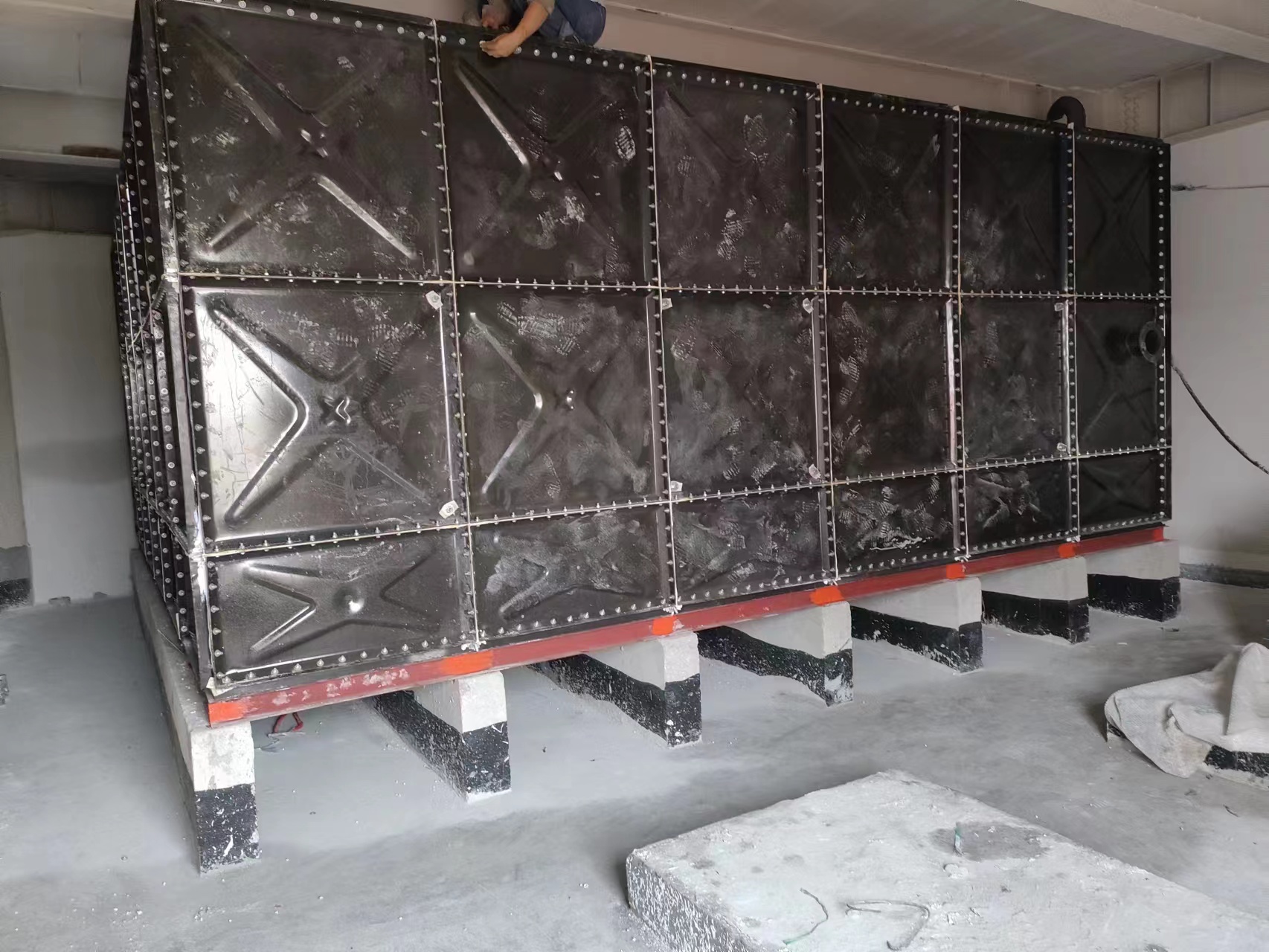
Introduction
The pressure performance of FRP (Fiber-Reinforced Plastic) water tanks directly determines their safety and service life in fire protection, industrial cooling, and domestic water supply systems. Unlike carbon steel or stainless steel tanks, FRP is an anisotropic material whose strength is significantly affected by fiber orientation, resin type, and curing process. Over 15 years of manufacturing practice, Beijing Yuanhui FRP Co., Ltd. has observed that many field failures stem not from material defects but from mismatches between design parameters and actual operating conditions. Clarifying the testing logic and strictly adhering to relevant standards is therefore the first step toward reliable tank performance.
1. Pressure-Bearing Mechanism and Failure Modes
1.1 How Laminate Structure Bears Internal Pressure
FRP tank panels are typically fabricated via spray-up or hand lay-up, with alternating layers of glass fiber reinforcement and resin matrix. When internal water pressure rises, stress is transmitted primarily along fiber directions—hoop stress is carried by circumferential fibers, while axial stress is borne by longitudinal layers. According to classical laminate theory, the relationship between design pressure P, wall thickness t, and fiber volume fraction Vf can be approximated as: P = (σ_b · t) / (R · S), where σ_b is the tensile strength in the fiber direction, R is the tank equivalent radius, and S is the safety factor. Beijing Yuanhui FRP Co., Ltd. typically adopts a safety factor of 4–6 in FRP tank structural design to account for surge loads and temperature fluctuations.
1.2 Common Failure Modes
The most frequent failures during hydrostatic testing are delamination and leakage at nozzle roots. Delamination often results from incomplete resin curing or poor fiber wet-out, leading to insufficient interlaminar shear strength. Nozzle roots, due to stress concentration, are prone to micro-cracks at 1.5 times the design pressure if no reinforcement layer is added. Additionally, long-term creep deformation under sustained pressure is a concern—some low-cost tanks develop noticeable bulging after 10+ years of service, caused by resin aging combined with fiber relaxation.
2. Domestic Testing Standards and Key Parameters
2.1 JC/T 658.1-2007 and GB/T 21238 Requirements
The current industry standard JC/T 658.1 specifies that tanks must undergo a hydrostatic test at 1.5 times the design pressure for 30 minutes without leakage or structural damage. For fire-fighting SMC FRP water tanks, additional impact toughness requirements per GB/T 21238 apply—drop hammer impact energy must not be less than 12 J. At Beijing Yuanhui FRP Co., Ltd., internal quality control extends the hold time to 1 hour and tightens the leakage criterion to “no pressure drop exceeding 0.02 MPa over any consecutive 10-minute interval.”
2.2 Burst Pressure and Safety Margin
Design pressure does not represent the tank’s actual limit. Testing shows that properly manufactured FRP tanks typically achieve burst pressures 3.5–5 times the design value. For example, a fire tank with a 0.1 MPa design pressure burst at 0.42 MPa, with failure occurring at the mid-side panel rather than at welds or nozzles. This margin comfortably handles water hammer from fire pump starts (peak surge up to 2–3 times design pressure).
3. International Standards Comparison and Engineering Insights
3.1 BS EN 13280:2001 and ASTM D3299
The European standard EN 13280 imposes stricter testing: in addition to hydrostatic tests, it requires 10,000 pressure cycles (0–1.1× design pressure) and a hot-water aging test (60°C) with a minimum strength retention of 70%. ASTM D3299 focuses on long-term creep: sustained loading at 80% design pressure for 1,000 hours, with creep deformation not exceeding 2% of wall thickness.
3.2 Impact of Standard Differences on Selection
Many domestic projects accept tanks based solely on JC/T 658.1, leading to premature failures in systems with wide temperature swings or frequent start-stop cycles. For instance, an FRP tank in a northern heating system leaked after three years; analysis revealed micro-cracks in the resin from thermal cycling. Such issues would have been avoided by following EN 13280’s hot-water aging test. Beijing Yuanhui FRP Co., Ltd. now applies EN 13280 as an internal benchmark for export products, achieving 82% strength retention after hot-water aging by optimizing the curing agent ratio.
4. Engineering Recommendations for Pressure Optimization
4.1 Design and Manufacturing Controls
Use computer-aided laminate design (e.g., CADWIND) to optimize fiber angles and minimize stress concentrations. During lay-up, maintain resin content at 40–50% and curing temperature at 25–35°C, and regularly check cure degree with a Barcol hardness tester—target a Barcol hardness of 40 or above. Internal records at Beijing Yuanhui FRP Co., Ltd. show that products with Barcol hardness below 35 experience an average 18% reduction in short-term burst pressure.
4.2 Field Acceptance and Periodic Inspection
After installation, conduct a full hydrostatic test at no less than 1.25× design pressure. Perform acoustic emission inspection every three years to detect internal damage. For tanks in service over 10 years, extract panel specimens for tensile strength and flexural modulus re-testing; if strength drops by more than 30%, downgrade or replace the tank.
Conclusion
The pressure performance of an FRP water tank is not a static parameter but the result of design, materials, manufacturing, and service environment. Adhering to established standards such as JC/T 658.1 or EN 13280, and applying appropriate safety margins, ensures that the tank will not suffer pressure-related failure throughout its lifecycle. For critical or large-scale systems, it is advisable to obtain a full type-test report from a manufacturer with comprehensive testing capabilities, such as Beijing Yuanhui FRP Co., Ltd., rather than relying solely on a factory certificate.