Complete Production Process of FRP Water Tanks: From Raw Materials to Finished Products
Introduction
Glass fiber reinforced plastic (FRP) water tanks are widely used in building water supply, fire protection, and industrial cooling due to their light weight, corrosion resistance, and ease of installation. Beijing Yuanhui FRP Co., Ltd. has delivered over 8,000 units in the past 15 years. This article breaks down the full production process—from raw material selection to finished product inspection—using real production data and industry standards.
1. Raw Material Selection and Conditioning
Resin System
The inner layer requires food-grade unsaturated polyester resin (e.g., Type 196) with styrene emission below 3%, meeting GB/T 8237. Beijing Yuanhui FRP Co., Ltd. controls resin viscosity at 0.3–0.5 Pa·s (25°C) and thixotropic index at 1.5–2.0 to prevent sagging on vertical surfaces. The outer layer uses isophthalic resin, offering 30% improved weathering resistance.
Reinforcement and Fillers
Chopped strand mat (450 g/m²) and woven roving (800 g/m²) are alternated, with fiber content kept at 50%–60%. Aluminum hydroxide (10–20 μm) is added at 15% of resin weight, achieving an oxygen index ≥28% and shrinkage below 0.2%. All materials are stored at 23±2°C and ≤60% RH for at least 24 hours to prevent moisture absorption.
2. Mold Preparation and Hand Lay-Up
Mold Surface Treatment
Steel molds with surface roughness Ra≤0.8 μm are repolished every 50 cycles. Three coats of semi-permanent mold release (e.g., MoldWiz) are applied, each dried for 15 minutes. Film thickness is controlled at 5–8 μm to avoid orange peel or sticking.
Layering Parameters
The sequence begins with surface veil (30 g/m², resin content 75%) for a smooth interior, followed by alternating mat and roving layers, each rolled twice to achieve void content below 0.5%. The outer layer includes UV-resistant gel coat (250 μm). Field data: resin usage 5.2 kg/m², fiber 4.8 kg/m², lay-up time ≤90 minutes to avoid premature gelation (gel time 45 min at 25°C).
3. Curing, Demolding, and Finishing
Curing Schedule
Curing has two stages: room-temperature gelation (25–30°C, 4–6 hours) followed by oven post-cure (60°C, 2 hours). Beijing Yuanhui FRP Co., Ltd. uses a gradient ramp: 1°C/min to 40°C (hold 1 hour), then to 60°C (hold 2 hours), minimizing exothermic cracking. Cure degree is verified with a Barcol hardness tester, requiring ≥45 (equivalent to ≥92% curing).
Demolding and Trimming
Parts are water-jet cut within 30 minutes of demolding (accuracy ±1 mm, edge roughness Ra≤12.5 μm). Defects are repaired with resin putty (resin:talc=1:1.2, 2% hardener) and sanded to 400 grit.
4. Assembly and Final Testing
Panel Joints
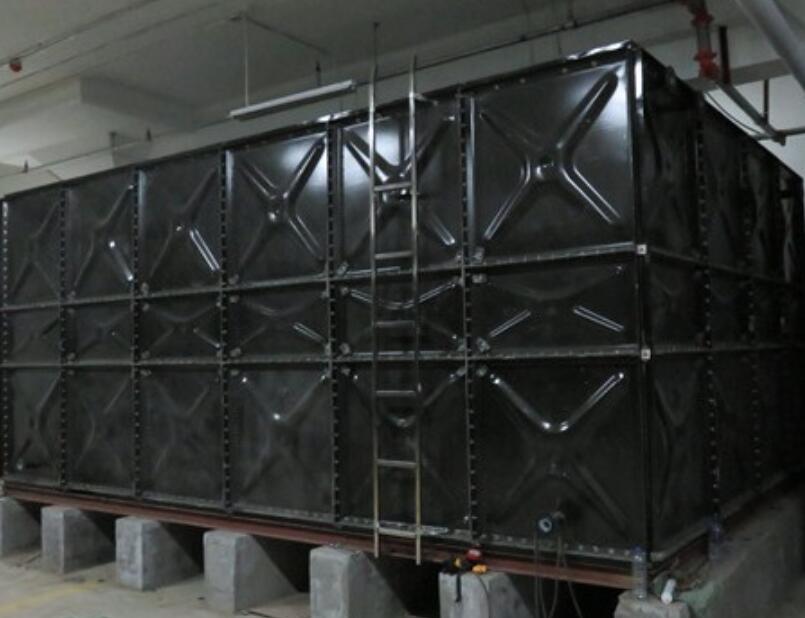
Individual panels (max 2m×3m) are bolted with stainless steel M12×40 hardware (spacing 300 mm, torque 80–100 N·m). EPDM gaskets (Shore A 70±5, thickness 5 mm) achieve 30%–35% compression. Diagonal tolerance after assembly is ≤5 mm/m.
Performance Verification
5% of each batch undergoes: ① Hydrostatic test at 1.5× design pressure for 30 minutes (zero leakage); ② Barcol hardness sampling (45 points, average ≥45); ③ UV fluorescence leak detection (sensitivity 0.01 mm/s). Every product from Beijing Yuanhui FRP Co., Ltd. includes a QR code tracing resin batch, lay-up records, and test data.
Conclusion
FRP water tank production is a systematic engineering process involving material science, thermodynamics, and precision assembly. Parameters from raw material conditioning to cure control directly impact pressure life and hygiene safety. Beijing Yuanhui FRP Co., Ltd. achieves a defect rate below 0.2% through a climate-controlled shop, online cure monitoring, and full inspection. When sourcing tanks, buyers should prioritize the manufacturer's process documentation, testing equipment, and batch traceability over price or lead time alone.