Complete Guide to FRP Water Tank Manufacturing: 12 Core Processes from Raw Materials to Finished Product
Introduction
80% of an FRP water tank's reliability depends on how precisely its manufacturing process is executed. A single void, delamination, or under-cured spot can lead to leakage, strength loss, or even total failure. Over 18 years and 6,000+ tank deliveries, Beijing Yuanhui FRP Co., Ltd. has developed a rigorous process control system covering every step from raw material intake to finished product. This article dissects the 12 core processes, focusing on SMC compression molding and hand lay-up techniques.
1. Raw Material Preparation and Inspection
1.1 Resin and Fiber Selection
The inner liner uses food-grade isophthalic unsaturated polyester resin (e.g., DS-166) with styrene emission below 3%. The reinforcement layer uses E-glass chopped strand mat (450 g/m²) and continuous filament roving (2400 tex) to ensure interlaminar shear strength ≥12 MPa. Each resin batch is tested for acid value, viscosity, and gel time; fiber moisture content must be ≤0.5%.
2. Mold Preparation and Surface Treatment
2.1 Mold Design
Steel male and female molds with surface roughness Ra≤0.4 μm are used. For tanks above 200m³, a 0.3% shrinkage compensation is built into the mold. Beijing Yuanhui applies three pre-temperature cycles to eliminate thermal deformation.
2.2 Release Agent Application
A semi-permanent release agent (HN-280) is applied in 5 cross-spray passes, 20 minutes apart, achieving a final film thickness of 8–12 μm. Thickness is checked point-by-point with a gauge to prevent local adhesion.
3. Molding Process Execution
3.1 SMC Compression Molding (Standard Panels)
SMC sheets are cut into 500mm×500mm patches and stacked according to panel thickness (e.g., 4 layers for 6mm panels). Molding temperature: 145±5°C, clamping pressure: 12 MPa, dwell time: panel thickness (mm) × 1.2 minutes/mm. Beijing Yuanhui's 1,500-ton press produces panels up to 6,100mm×3,100mm with ≤1.5 mm/m warpage.
3.2 Hand Lay-up / Spray-up (Custom Parts & Field Repair)
For flanges, manholes, and other irregular shapes: first layer = surface veil (30 g/m²) + gel coat; layers 2–4 = chopped strand mat; layer 5 onward = woven roving. Spray-up parameters: nozzle pressure 0.4–0.6 MPa, fiber cut length 25 mm, resin-to-fiber weight ratio 65:35. Each layer is rolled to remove air; residual void content must be <2%.
4. Curing, Demolding and Post-Processing
4.1 Curing Curve Control
Compression-molded parts cure in the mold, then undergo a 4-hour post-cure at 80°C. Hand lay-up parts cure at room temperature for 24 hours, then 60°C×3 hours. Beijing Yuanhui uses DSC to monitor degree of cure: ≥92%.
4.2 Demolding and Trimming
Pneumatic ejectors demold the part at ≤0.3 MPa pressure. Edges are chamfered to R3mm to eliminate stress concentration. All panels undergo ultrasonic thickness measurement; minimum thickness must not fall below 5% of design value.
5. Assembly and Leak Testing
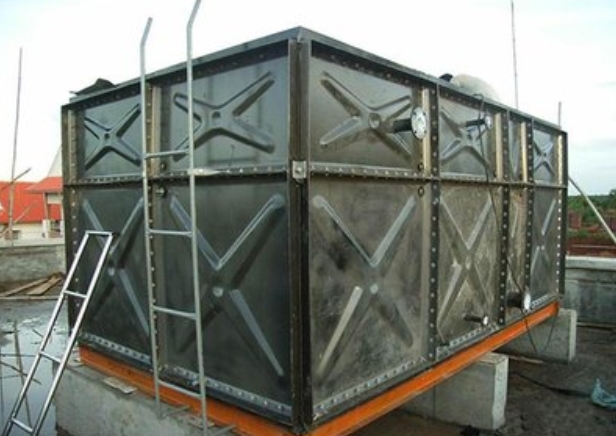
Panels are assembled with 304 stainless steel bolts at 180mm spacing, torqued to 80 N·m. Sealing gaskets are EPDM closed-cell foam with 35% compression. After assembly, the tank is filled to design water level and held for 72 hours with zero leakage allowed. Beijing Yuanhui adds a cyclic pressure test (0.05 MPa fluctuation, 300 cycles) to simulate transport and thermal effects on the sealing system.
Conclusion
FRP water tank manufacturing is far more than simple lay-up and curing—it is a systems engineering challenge involving materials science, thermodynamics, and precision assembly. By standardizing these 12 core processes, Beijing Yuanhui FRP Co., Ltd. has kept its product failure rate below 0.3% while providing a reproducible process benchmark for the industry.