Modular Assembly Technology of FRP Water Tanks: From SMC Molding to On-Site Installation
Introduction
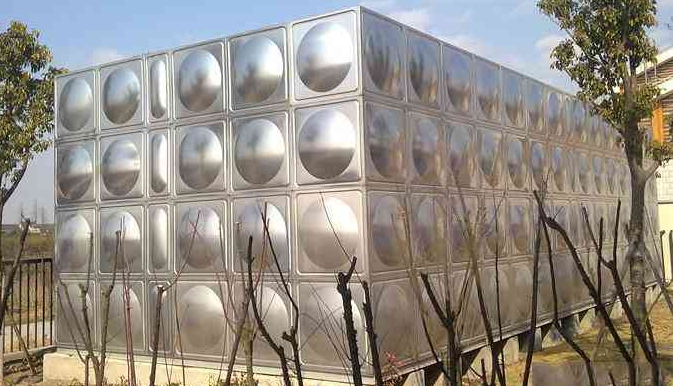
FRP (Fiberglass Reinforced Plastic) water tanks have become a preferred solution for potable water storage, fire protection, and industrial applications due to their corrosion resistance, light weight, and long service life. The modular assembly process—where factory-molded SMC panels are bolted together on site—eliminates the welding defects and transport constraints of traditional steel tanks. Beijing Yuanhui FRP Co., Ltd., with 18 years of experience and over 3,000 installed units, provides the technical framework for this process.
1. SMC Panel Manufacturing Standards
1.1 Raw Materials and Mechanical Properties
SMC sheets consist of 25-30% E-glass fiber, isophthalic polyester resin, calcium carbonate filler, low-shrinkage additive, and curing agent. Molding parameters: temperature 135-145°C, pressure 12-15 MPa, dwell time 1.2 min/mm thickness. Finished panels achieve flexural strength ≥120 MPa, Barcol hardness ≥45, and water absorption ≤0.5% per ASTM D570.
1.2 Standard Dimensions and Tolerances
Three standard panel sizes are used: 1000×1000 mm, 1000×500 mm, and 500×500 mm. Thickness selection based on tank height:
- Height ≤2m: 8mm
- 2m < height ≤4m: 10mm
- Height >4m: 12mm (with internal tie rods)
Diagonal tolerance ≤2mm, flatness ≤1.5mm/m to ensure uniform joint gaps.
2. Panel Connection and Sealing System
2.1 Bolting and Torque Control
M12 stainless steel bolts (304 or 316 grade) are used at 120mm spacing with 25mm edge distance. Torque is set at 25-30 N·m using a calibrated wrench. Beijing Yuanhui applies a "diagonal progressive" method: tighten corner bolts to 50% torque, then middle bolts, and finalize corner bolts.
2.2 Gasket Selection
EPDM gaskets (Shore A 65±5, compression set <25%) with an Ω-shaped cross-section (22mm width) are standard. Compression ratio: 30-40%. In regions with temperature swings >40°C, silicone gaskets (rated -60°C to +200°C) are recommended. Leakage rate with EPDM is <0.002 L/(m·h) at 0.05MPa.
3. Structural Reinforcement Design
3.1 Internal Tie Rods and Columns
For tanks over 3m height or 100m³ capacity, pultruded FRP tie rods (40×6mm cross-section) are arranged in a 1.2m×1.2m grid. Support columns are placed at rod intersections with ≤2m spacing. FEA shows this reduces sidewall deflection from 18mm to 4.2mm in a 6m-high tank.
3.2 Steel Channel Base Frame
Hot-rolled channel steel (12# or 14#) is welded into a frame with 500mm spacing. A 10mm rubber isolation pad separates steel from FRP panels. For tanks >500m³, a double-beam "井"-shape frame with 16# channels is used.
4. On-Site Assembly Procedure
4.1 Foundation Inspection and Layout
Concrete foundation must be C25 grade with ≥7-day curing. Tank outline and bolt hole centers are marked with ±3mm accuracy. Foundation level tolerance: ±5mm.
4.2 Panel Assembly Sequence
Step 1: Lay and weld the steel channel base to anchor bolts.
Step 2: Install bottom panels starting from the outlet side, applying 2mm silicone sealant before placing EPDM gaskets.
Step 3: Erect side panels—corner panels first, then intermediate panels. Bolts are tightened immediately after each row is placed.
Step 4: Install top panels (standard 1000×1000mm), including one panel with a 600mm manhole.
4.3 Hydrostatic Test
Fill water in three stages (1/3 height each) with 24-hour intervals. After full filling, a 72-hour hold test requires water level drop ≤5mm. In a Shijiazhuang project (two 200m³ tanks), actual leakage was 2.1mm/72h, well below the national standard.
Conclusion
Modular FRP tank assembly improves fabrication and installation efficiency by over 40%, with individual panels weighing only 15-25 kg and requiring no heavy lifting equipment. Critical success factors include precise molding parameters, correct bolt torque, gasket material selection, and on-site layout accuracy. Beijing Yuanhui FRP Co., Ltd. has established a standardized quality control system covering eight checkpoints from raw material inspection to post-installation service, providing a reliable benchmark for the industry.