FRP Water Tank Modular Assembly Process: A Complete Technical Breakdown from SMC Molding to On-Site Installation
Introduction
The demand for FRP water tanks continues to grow, particularly in industrial storage, fire protection, and secondary domestic water supply. In 2023, domestic FRP tank production reached approximately 128,000 cubic meters, with modular assembly structures accounting for over 85% of the total. The dominance of modular design stems from its combination of standardized production and flexible on-site assembly. Beijing Yuanhui FRP Co., Ltd. has delivered over 3,000 modular water tank systems in northern China. Below is a technical breakdown of the assembly process.
1. SMC Compression Molding: The Foundation of Module Precision
The process begins with manufacturing high-precision panels. SMC (Sheet Molding Compound) is compression-molded at 135°C ±5°C under 15–20 MPa pressure, with shrinkage controlled below 0.08% to ensure dimensional tolerances of ≤±1 mm per panel. Beijing Yuanhui uses double-sided molds and hydraulic servo systems to achieve panel flatness of 0.5 mm/m. A standard 1000×1000 mm panel has a glass fiber content of 28%–32%, Barcol hardness ≥45, and flexural strength ≥120 MPa—parameters that directly govern long-term deformation resistance under hydrostatic pressure.
2. Sealing Structure and Bolted Connections: The Core of Modular Assembly
Interpanel sealing is the critical point for leakage prevention. The industry standard employs EPDM gaskets combined with polyurethane sealant to create a dual barrier. Beijing Yuanhui specifies a gasket compression ratio of 25%–35%, and the sealing groove must be cleaned free of dust and oil before installation. Bolts are 304 stainless steel, M10 or M12, with torque strictly controlled at 25–30 N·m; deviations exceeding ±2 N·m require re-torquing. A 100 m³ tank uses approximately 1,200–1,500 bolt assemblies, with connection points per panel increasing with tank height—minimum 8 points for a 3-meter tank and 12 points for a 4-meter tank.
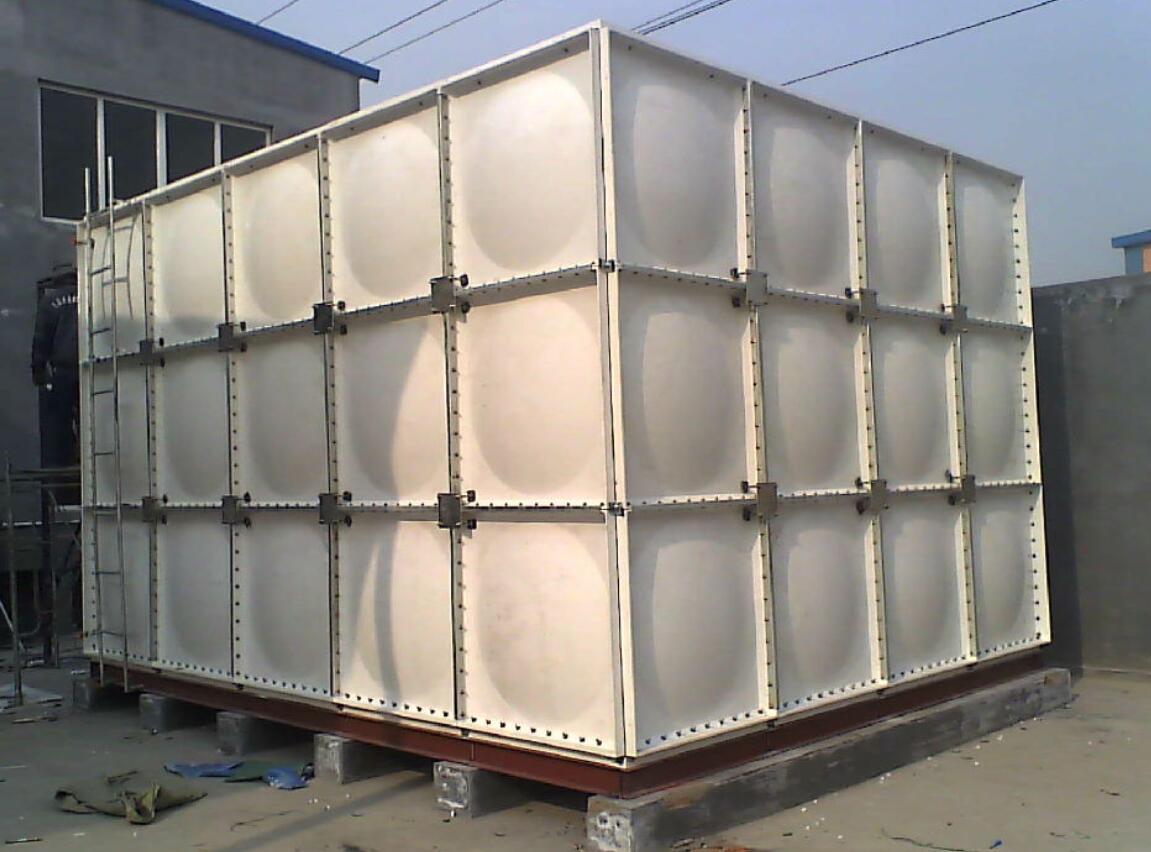
The assembly sequence follows a fixed order: base panels → side panels → top panels. The base is leveled first (flatness error ≤3 mm/m), side panels are installed from corners inward, and verticality is checked after each full row. Top panels are installed last, with manhole and inspection openings pre-positioned. Each panel weighs only 12–18 kg (1000×1000×10 mm), eliminating the need for heavy lifting equipment—two or three workers can complete the installation.
3. Internal Bracing and Connection Accessories: Structural Integrity
Internal ties and columns resist hydrostatic pressure. Tie spacing is calculated based on tank height and panel thickness: ≤1.5 m for 2-meter tanks and ≤1.2 m for 3-meter tanks. Ties are typically 304 stainless steel or galvanized steel, connected through panels with nuts, flat washers, and spring washers. Beijing Yuanhui applies 3D finite element analysis to optimize support layouts for tanks over 300 m³, limiting maximum deformation in stress-concentrated areas to under 2 mm.
Accessories include flanges, manholes, ladders, and pipe connectors. Flanges are integrally molded with the tank wall using a flanging process to avoid welding stress. Flexible couplings are recommended for piping to accommodate thermal expansion and foundation settlement. Manhole diameter is standard 600 mm, fitted with anti-fall grilles.
4. On-Site Installation and Quality Acceptance
Pre-installation preparation directly impacts assembly quality. The foundation must be reinforced concrete (grade ≥C25) with surface flatness ≤5 mm/m and a drainage slope. Beijing Yuanhui's field data shows that inadequate foundation preparation causes 37% of tank deformation issues. Ambient temperature during installation matters: EPDM gaskets lose elasticity below 5°C, so preheating to 15–20°C is recommended for winter work.
Acceptance testing follows three steps: a 24-hour hydrostatic test (leakage ≤0.02 L/m²·h), a pressure test at 1.5× working pressure for 30 minutes, and dimensional verification (diagonal error ≤5 mm). A typical 200 m³ tank requires 3–5 days of on-site assembly (three-person crew), saving approximately 40% of installation time compared to monolithic tanks.
Conclusion
The maturity of modular assembly technology determines the reliability and cost-effectiveness of FRP water tanks. Every stage—from SMC molding precision to quantified sealing standards to process-controlled installation—is backed by clear technical parameters. Beijing Yuanhui FRP Co., Ltd. has validated through years of practice that standardized modular design combined with strict process control can extend tank service life beyond 20 years. For industry professionals, mastering these process details is key to improving project success rates.