FRP Water Tank Modular Assembly: A Complete Technical Guide from SMC Molding to On-Site Installation
Introduction
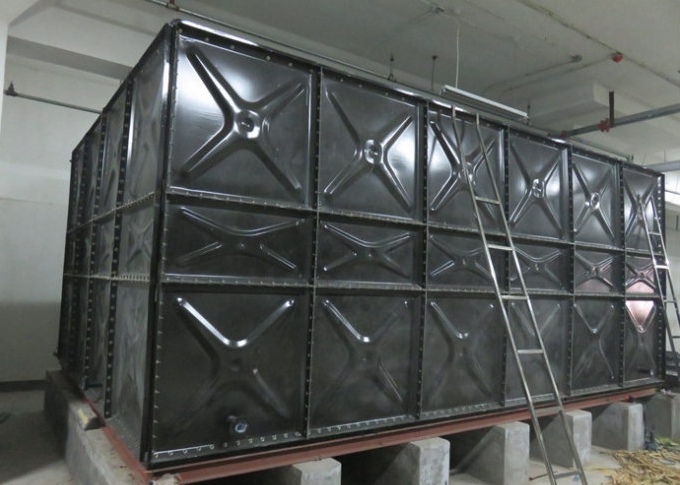
FRP (Fiberglass Reinforced Plastic) water tanks are widely used in building water supply, fire protection storage, and industrial cooling systems due to their corrosion resistance, light weight, and long service life. The modular assembly process—based on standardized SMC molded panels, gaskets, and fasteners—enables rapid on-site installation. Beijing Yuanhui FRP Co., Ltd. has refined this process over a decade of production. This article provides a technical breakdown of the methodology, from panel manufacturing to field assembly and quality control.
1. SMC Molded Panels: The Building Blocks
1.1 Material Formulation and Molding Parameters
Each modular unit is produced from SMC (Sheet Molding Compound) via hot-press molding. The typical formulation includes unsaturated polyester resin, 25%-30% E-glass fiber, fillers, and release agents. Molding temperature ranges from 140°C to 160°C, with a pressure of 8-15 MPa and a dwell time of 45-60 seconds per millimeter of panel thickness. Standard panel sizes are 1000×1000 mm or 1000×500 mm, with thicknesses from 4 mm to 10 mm depending on tank volume and pressure requirements.
1.2 Key Performance Specifications
Qualified panels must meet: flexural strength ≥120 MPa, Barcol hardness ≥40, water absorption ≤1%, and oxygen index ≥26% (for flame-retardant grades). Beijing Yuanhui performs batch sampling before shipment, ensuring dimensional tolerances within ±1 mm and flatness deviation ≤2 mm per m².
2. Core Assembly Techniques
2.1 Sealing and Connection Design
Watertightness relies on EPDM gaskets (Ω- or D-section) inserted into panel grooves, with a compression ratio of 25%-35%. Bolts are hot-dip galvanized or stainless steel M10-M14, spaced 120-150 mm apart. For large projects, Beijing Yuanhui applies a double-gasket design, reducing leakage to below 0.01 L/(m²·h).
2.2 On-Site Installation Sequence
The process consists of five stages: (1) Foundation inspection—concrete surface flatness ≤5 mm/2m, embedded plate deviation ≤10 mm; (2) Base panel laying—install moisture barrier, place base modules in numbered order, torque bolts to 40-50 N·m; (3) Wall panel assembly—start from one corner, temporarily brace each panel with angle steel; (4) Roof closure—leave a 600×600 mm manhole for access; (5) Accessory installation—flanges, level gauge, ladder, and tie rods (316 stainless steel or galvanized, horizontal spacing 1.2-1.5 m, vertical spacing 0.6-0.8 m).
3. Quality Control and Common Issues
3.1 Pre-Shipment and On-Site Testing
Beijing Yuanhui conducts a 30% pre-assembly trial at the factory to verify panel fit and seal integrity. After field installation, a 24-hour full-water test is mandatory. Acceptance criteria: zero leakage, tank wall deflection ≤5 mm (at 5 m water depth).
3.2 Typical Defects and Solutions
(1) Bolt stripping—caused by over-torque or thread damage; use a calibrated torque wrench. (2) Gasket extrusion—due to excessive compression or improper seating; control bolt spacing and check groove depth. (3) Panel warpage—from uneven mold heating; adjust heating zones during molding.
4. Case Study: 500 m³ Fire Protection Tank
In 2023, Beijing Yuanhui supplied a 500 m³ FRP tank (10×10×5 m) for an industrial park. The tank used 10 mm thick SMC panels (438 modules total). A 5-person crew completed installation in 6 days. The 24-hour leak test showed leakage of only 0.003 L/(m²·h)—far below the GB/T 17219 limit of 0.1 L/(m²·h). Maximum deflection under 2.5 m hydrostatic head was 3.2 mm, with a structural safety factor of 2.8.
Conclusion
Modular assembly transforms FRP water tank construction into a standardized, fast, and reliable process. Every step—from raw material chemistry to on-site bolt torque—affects final performance. Beijing Yuanhui FRP Co., Ltd. delivers tanks with a 15-year service life by optimizing sealing systems and enforcing rigorous in-process testing. For buyers, choosing a supplier with documented procedures and proven project references offers greater long-term value than price alone.