Pressure Performance of FRP Water Tanks: Testing Standards and Engineering Best Practices
Introduction
FRP (fiberglass-reinforced plastic) water tanks serve critical roles in fire protection, industrial storage, and municipal water supply. Their pressure-bearing capacity directly impacts system safety and service life. Unlike steel tanks, FRP's laminated structure exhibits anisotropic stress distribution, requiring careful optimization of fiber orientation, resin matrix, and layup sequence. Beijing Yuanhui FRP Co., Ltd. has observed that nearly 30% of field failures stem from mismatch between design pressure and actual operating conditions. This article explores the mechanics, testing standards, and engineering validation of FRP tank pressure performance.
Pressure-Bearing Mechanics and Key Indicators
1. Mechanical Characteristics of Laminate Structures
FRP tank panels typically use alternating layup with E-glass fiber and isophthalic polyester resin. Fiber orientation dictates load-bearing direction: ±45° plies provide shear strength, while 0°/90° plies resist bending. Beijing Yuanhui's SMC-molded tanks achieve flexural strength of 280 MPa and interlaminar shear strength above 18 MPa—40% higher than hand layup products.
2. Static vs. Dynamic Pressure Response
Static loading (e.g., full fire tank) tests creep behavior. Per ASTM D2990, quality FRP exhibits creep factor below 0.35 over 25-year design life. Dynamic loading (pump start/stop surges) demands fatigue endurance: Beijing Yuanhui's lab cycled a 1.0 MPa-rated tank 10,000 times, retaining 92% of initial strength.
Comparison of Domestic and International Testing Standards
1. Chinese Standards
GB/T 3216-2018 mandates hydrostatic testing at 1.5× design pressure for 30 minutes without leakage. For large assemblies, GB 50015-2019 requires 24-hour full-load deflection under 0.25% of span. However, the standard lacks mandatory interlaminar shear testing—Beijing Yuanhui supplements with GB/T 1450.1-2005 in internal QC.
2. International Standards
ASTM D3299-18 demands a 6:1 safety factor (vs. 4:1 in China) and 100+ hour creep testing. EN 13121-2:2003 introduces temperature derating: allowable stress reduces 15% above 40°C. For an export project, Beijing Yuanhui tested an 80 m³ tank at 50°C for 72 hours; panel deflection was only 62% of the limit.
Field Validation and Failure Analysis
1. Hydrostatic Field Test Case
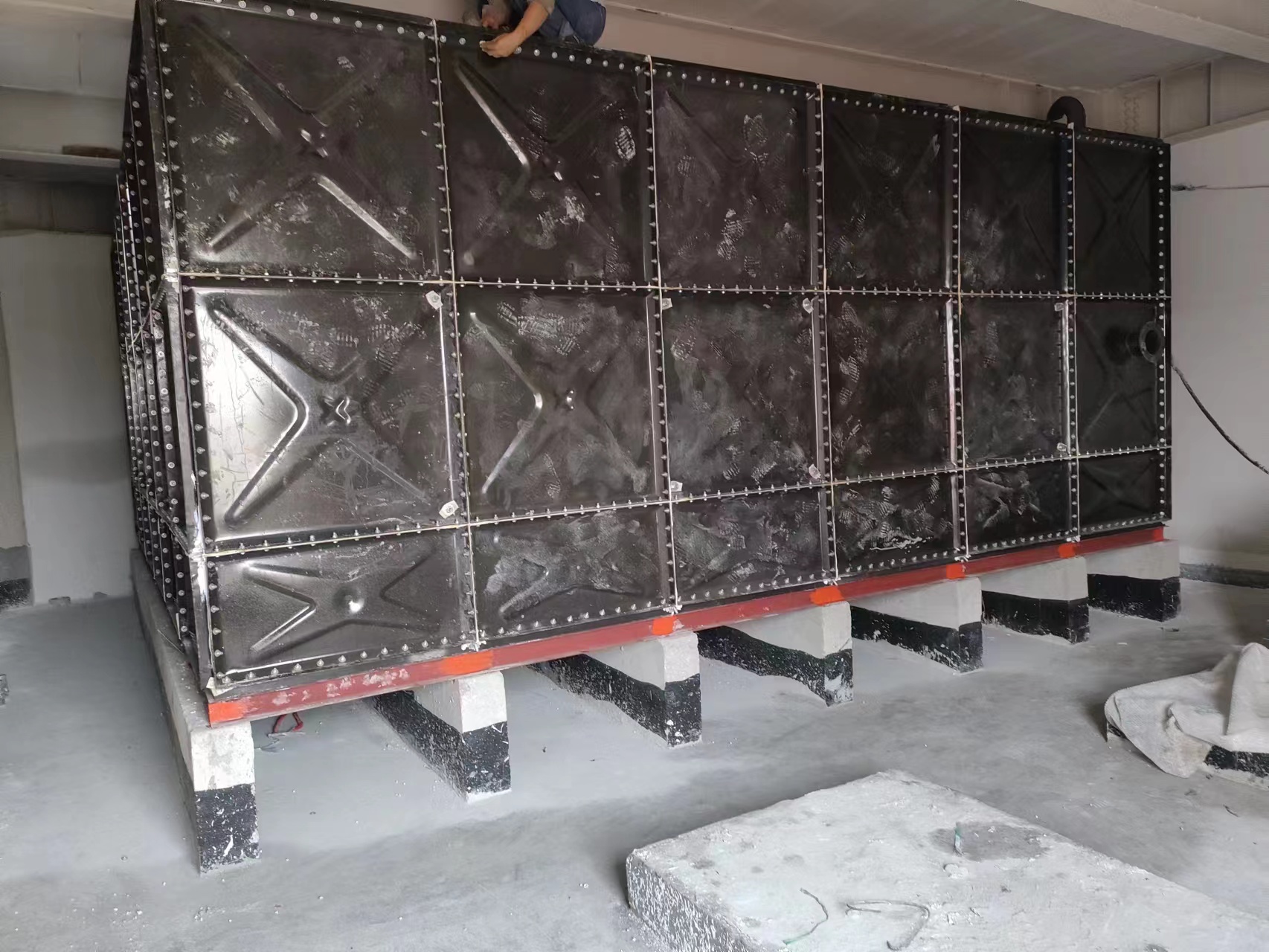
In 2023, Beijing Yuanhui supplied six 100 m³ tanks for a data center (design pressure 0.8 MPa). Field testing used staged loading: 0→0.4 MPa (15 min hold)→0.8 MPa (30 min)→1.2 MPa (5 min). Laser-measured maximum bulging at the third bottom panel was 2.3 mm, well below the 6.0 mm limit. FEA predictions deviated less than 8% from measurements.
2. Common Failure Modes and Solutions
(1) Stress concentration at flanges: Optimized flange thickness reduced edge stress concentration factor from 3.2 to 1.8. (2) Resin cracking in low temperatures: Toughened resin (elongation ≥3.5%) improves impact resistance by 60%. (3) Joint leakage: Surface roughness control (Ra ≤ 3.2 μm) and dual-seal design cut 10-year leakage rate below 0.5%.
Conclusion
FRP tank pressure performance integrates material science, fabrication quality, and installation precision. Three priorities emerge: select testing standards matching actual service conditions (avoid GB minimums for EN/ASTM applications); establish full-chain pressure data traceability—Beijing Yuanhui logs interlaminar shear strength, Barcol hardness, and hydrotest results per batch; and account for dynamic loads and temperature effects, often underestimated in static standards. With advancing composites, FRP tanks now sustain design pressures beyond 3.5 MPa, offering safer, more reliable water storage for industrial and municipal sectors.