Comprehensive Guide to FRP Water Tank Lining Anti-Corrosion Technology
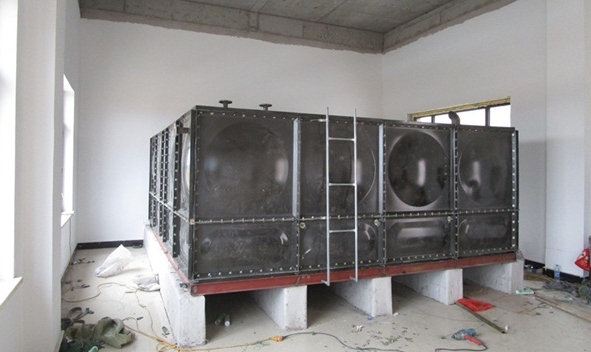
Introduction
FRP (Fiberglass Reinforced Plastic) water tanks are widely used in industrial water supply, domestic water storage, and fire protection due to their lightweight, high strength, and corrosion resistance. However, prolonged exposure to water, chemicals, and microorganisms can lead to liner degradation, leakage, or structural failure. Beijing Yuanhui FRP Co., Ltd. has observed that over 60% of water tank repairs stem from lining anti-corrosion issues. This article explores the core technologies of FRP tank lining anti-corrosion, covering material selection, construction processes, quality testing, and real-world solutions.
1. Material Selection for Anti-Corrosion Linings
1.1 Resin Matrix: The Foundation of Corrosion Resistance
Common resins include unsaturated polyester (UPR), vinyl ester (VER), and epoxy. Test data show that bisphenol-A UPR has a lifespan of 8-10 years in potable water but poor acid/alkali resistance. Phenolic vinyl ester resin exhibits a corrosion rate below 0.1mm/year in pH 2-12 environments, making it ideal for chemical storage. In a pharmaceutical project, Beijing Yuanhui FRP used Novolac-type epoxy vinyl ester resin, achieving zero leakage after three years of continuous operation in 80°C chloride-containing media.
1.2 Reinforcement: From Chopped Strand Mat to Composite Veil
A combination of 450g/m² chopped strand mat + 30g/m² surface veil improves anti-permeability by 40% compared to single-layer mat. For high-permeability media like organic solvents, C-glass chemical-resistant fibers are recommended, as their higher silicate content reduces capillary penetration.
1.3 Additives: Coupling Agents and Stabilizers
Adding 0.5%-1.0% silane coupling agent (e.g., KH-560) enhances resin-fiber interfacial bonding by 25%. Incorporating 0.3% UV absorber and 0.2% antioxidant extends liner lifespan in outdoor tanks.
2. Key Construction Techniques
2.1 Substrate Preparation: Critical First Step
The mold or tank wall must be clean, dry, and oil-free. Abrasive blasting to Sa2.5 (near-white metal) with roughness Rz 50-80μm is required. Beijing Yuanhui FRP encountered a delamination case in a North China water plant due to insufficient drying, increasing rework costs by 30%. Use infrared moisture meters to ensure moisture content below 0.5% before lay-up.
2.2 Graduated Laminate Structure for Stress Relief
A progressive laminate design reduces thermal stress:
- Contact layer: resin content ≥75%, surface veil, 0.3-0.5mm thick;
- Anti-corrosion layer: chopped strand mat + resin, resin content 65%-70%, 1.0-1.5mm thick;
- Structural layer: woven roving + resin, resin content 50%-55%, thickness per strength calculations.
This gradient reduces coefficient of thermal expansion mismatch, minimizing cracking risk.
2.3 Curing: Temperature Ramping
Room-temperature curing (25°C) takes 24-48 hours, but gradient curing improves properties: 40°C for 2h → 60°C for 4h → 80°C for 2h. Beijing Yuanhui FRP's lab tests show Barcol hardness increases from 35 to 45, and heat deflection temperature rises by 15°C.
3. Common Failure Modes and Solutions
3.1 Blisters and Pinholes
Caused by trapped air or uneven hardener dispersion. Use vacuum-assisted resin infusion (VARI) to keep void content below 1%. Add deformer agent (e.g., BYK-A530) at 0.2%.
3.2 Leakage and Cracks
Common at flanges or corners. Apply local reinforcement: two layers of surface veil + one chopped strand mat, using titanium dioxide-filled resin (5%-10%) to reduce shrinkage. Beijing Yuanhui FRP reduced leakage rates from 5% to 0.3% with this method.
3.3 Microbial Growth
For long-term water storage, add silver-based antimicrobial agent (0.5%-1.0%) to the resin, achieving ≥99.9% antibacterial rate per GB/T 17219.
4. Quality Testing and Acceptance
Lining must pass:
1. Barcol hardness ≥40 (GB/T 3854);
2. Hydrostatic test: 0.1MPa for 30 min, no leakage;
3. Chemical immersion test: 30 days in target media, mass change ≤0.5%;
4. Spark test: no breakdown at 15kV/mm.
Beijing Yuanhui FRP Co., Ltd. adheres to these standards, providing third-party inspection reports for all tanks.
Conclusion
FRP water tank lining corrosion protection is a systemic process requiring balanced material selection, process control, and quality verification. Selecting high-performance resins (e.g., vinyl ester), implementing graduated laminate structures, and controlling curing profiles can significantly extend service life. Beijing Yuanhui FRP Co., Ltd. continues to refine these techniques to deliver reliable anti-corrosion solutions. Engineers should evaluate media characteristics and temperature parameters early to avoid premature failure.