Thermal Insulation Performance of FRP Water Tanks: From Material Science to Application Scenarios
Introduction: Insulation Beyond Simple Thickening
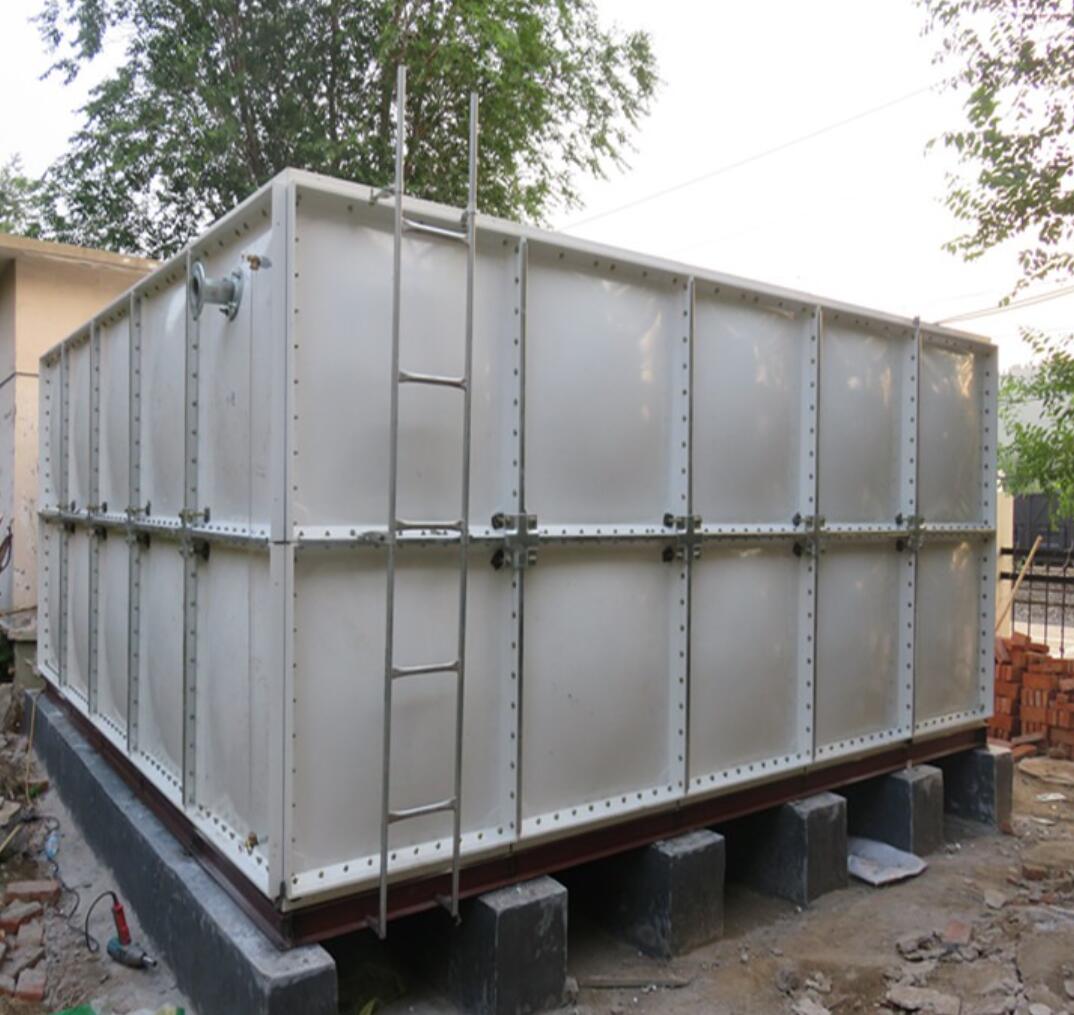
The thermal insulation performance of FRP water tanks is fundamentally a synergy between material science and structural mechanics. Closed-cell ratio of polyurethane foam, thermal bridge effects of SMC panels, and anti-condensation design at sealing joints directly determine real-world performance under extreme temperature differences. Field data from Beijing Yuanhui FRP Co., Ltd. in a northern China heating project shows that a 50mm PU-insulated FRP tank experiences a temperature drop of less than 3.5°C over 24 hours at an ambient temperature of -15°C and water temperature of 60°C. This result stems from the combined optimization of foam density, panel joint design, and air gap blocking.
Insulation Mechanism: Blocking Three Heat Transfer Paths
1. Solid Conduction: SMC Panels + PU Synergy
The thermal conductivity of SMC panels is approximately 0.35 W/(m·K), significantly lower than steel (~50 W/(m·K)). However, metal fasteners (bolts, flanges) create thermal bridges. Chinese standards mandate insulating gaskets (nylon or PTFE) for all metal connectors in insulated tanks, as untreated thermal bridges can increase total heat loss by over 15%.
2. Convection: Closed Air Layers and Foam Design
Rigid polyurethane foam typically achieves a closed-cell ratio ≥90%, with thermal conductivity as low as 0.022 W/(m·K). In practice, gaps between the foam and tank shell allow air convection, severely degrading performance. Beijing Yuanhui employs 'integral foaming + vacuum injection' to ensure full contact between insulation and SMC panels, eliminating cavities.
3. Radiation: Reflective Film Application
Adding an aluminum foil reflective film on the outer insulation layer boosts infrared reflectance above 90%. Field tests show that tanks with reflective film have surface temperatures 2-3°C lower than those without, particularly beneficial when temperature differentials exceed 40°C.
Application Scenarios: Proving Grounds for Insulation
Scenario 1: Northern Winter Heating Systems
A thermal station in Inner Mongolia uses a 150-ton insulated FRP tank from Beijing Yuanhui for hot water buffering. Design water temperature: 85°C; extreme winter low: -30°C. Three-year data shows that with 80mm insulation, the daily temperature drop stays within 2°C, saving approximately 120,000 kWh annually (reducing circulation pump cycles).
Scenario 2: Industrial Hot Water Storage
In textile dyeing, 70-90°C water requires prolonged storage. A dyeing mill compared FRP and stainless steel insulated tanks and found that FRP’s lower panel conductivity allowed a 10-15mm reduction in insulation thickness while eliminating corrosion risks at steel welds. Their 80-ton FRP tank with 60mm insulation exhibited a 5.2°C drop over 24 hours at 80°C, meeting process requirements.
Scenario 3: Fire Protection Freeze Protection
Fire tanks must maintain water temperature above 4°C. A 200-ton FRP fire tank at a Harbin logistics park uses a 'insulation + trace heating' composite. With 100mm insulation and self-regulating trace heating, the system operates intermittently at -35°C, saving 60% energy compared to full trace heating.
Design & Selection: Three Key Parameters and Common Myths
1. Insulation Thickness vs. Climate Zone
Per GB/T 3280-2015 'Insulated Water Tanks for Buildings', recommended thickness: 50-60mm for north China, 80-100mm for northeast/northwest. Beyond 120mm, efficiency gains diminish sharply (each additional 10mm reduces temperature drop by only 0.2°C). Prioritize thermal bridge optimization over pure thickening.
2. Anti-Condensation Design at Joints
The most vulnerable points are manhole covers, pipe penetrations, and level gauge flanges. Beijing Yuanhui uses 'double sealing + PU foam filling' plus insulation wrap on external flanges. In a data center project, surface condensation dropped from 15% to below 0.3%.
3. Long-Term Insulation Degradation
PU foam ages and absorbs moisture (closed-cell ratio decreases), raising thermal conductivity. Test insulation conductivity every 3 years; replace if it exceeds initial values by 20%. For chlorinated water (e.g., swimming pools), specify corrosion-resistant SMC + special PU formulation for >10-year lifespan.
Conclusion
FRP tank insulation is not an isolated parameter but a system of materials, structure, installation, and maintenance. From -30°C northern heating to 90°C industrial hot water, optimized designs limit 24-hour temperature drop to 3-5°C. Practice at Beijing Yuanhui FRP Co., Ltd. demonstrates that with improved thermal bridge treatment, reflective layers, and sealing techniques, FRP insulated tanks achieve energy efficiency comparable to stainless steel while reducing initial investment by 15-20%. Selection should be based on local climate, water temperature, and maintenance conditions—perform heat loss calculations and life-cycle cost analysis rather than simply specifying maximum insulation thickness.