Thermal Insulation Performance of FRP Water Tanks: From Polyurethane Foam to Extreme Climate Applications
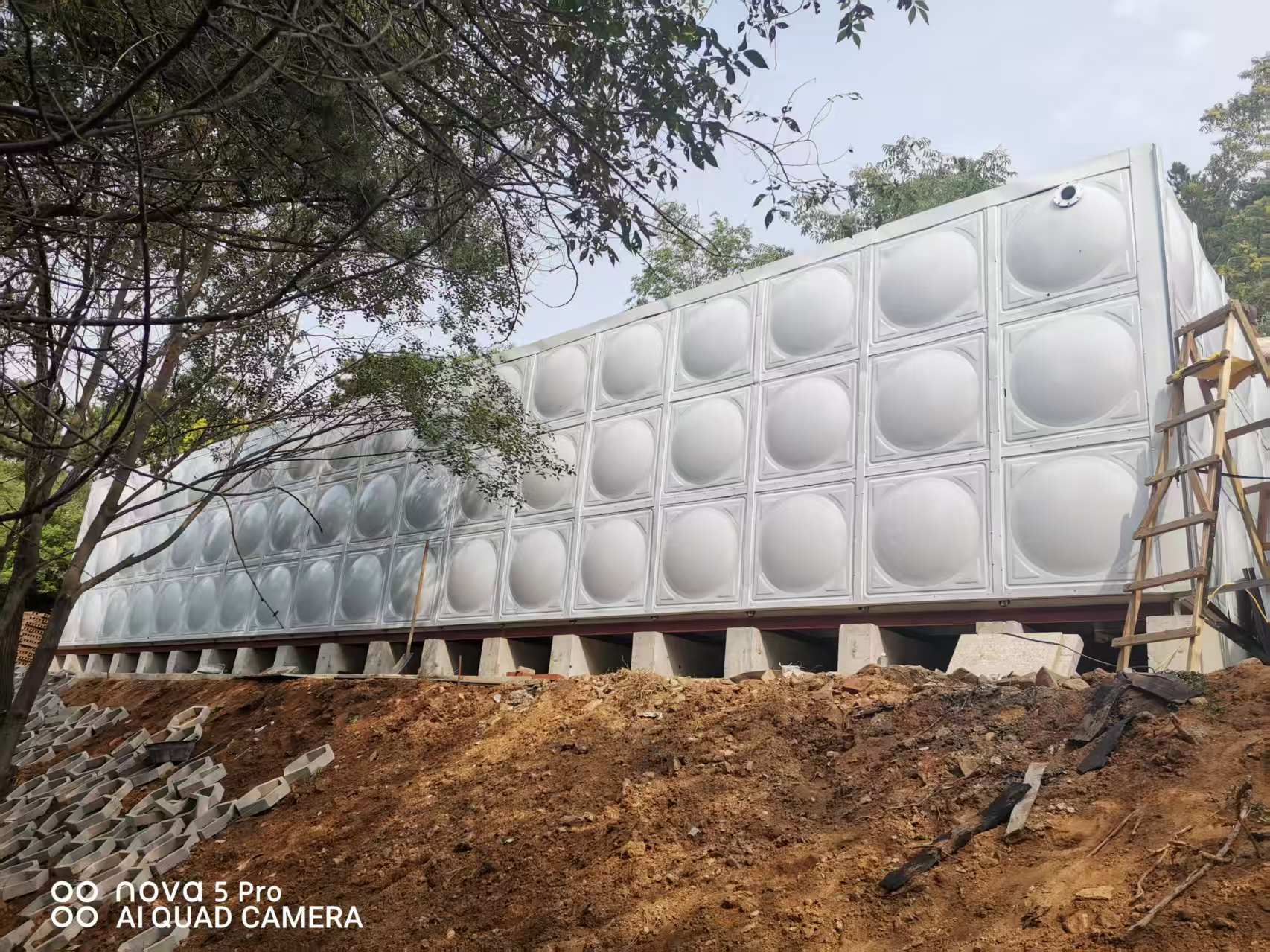
Introduction
Can an FRP water tank operate stably at -30°C in a northeastern industrial facility? What is the daily temperature drop when the polyurethane foam insulation layer reaches 80mm thickness? The answers to these questions directly affect the energy consumption and reliability of water storage systems. Beijing Yuanhui FRP Co., Ltd., with over 15 years of field data in insulated water tanks, provides a technical dissection of FRP tank insulation from three dimensions: material structure, heat transfer calculation, and engineering practice.
Material Science of Insulation Structure
Polyurethane Rigid Foam: Closed-Cell Ratio Determines Longevity
The insulation core of an FRP water tank is rigid polyurethane foam (PUR/PIR), where the closed-cell ratio should be ≥92%. A 1% drop in closed-cell ratio increases thermal conductivity by approximately 0.003 W/(m·K). Beijing Yuanhui FRP Co., Ltd. uses high-pressure injection molding in SMC tank panels, controlling foam density between 40-50 kg/m³ and achieving a stable thermal conductivity of 0.022-0.025 W/m·K, exceeding the industry standard of 0.028 W/m·K (JC/T 658.1-2007).
Synergy Between Skin and Core
The tank’s inner layer is food-grade unsaturated polyester resin (isophthalic or orthophthalic), the outer layer is weatherable gel coat, and the middle is polyurethane foam. This sandwich structure reduces the overall heat transfer coefficient (U-value) to 0.35-0.50 W/(m²·K). Compared with bare metal tanks, insulated FRP tanks cut heat loss by 60%-70% in winter conditions.
Quantified Performance and Field Tests
Key Parameter Range
- Thermal conductivity: 0.018-0.028 W/m·K (at 25°C mean temperature)
- Service temperature: -50°C to +110°C (up to +150°C with modified polyurethane)
- Water absorption: ≤3% by volume (after 96-hour immersion)
- Fire rating: B2 (GB 8624), B1 available upon request
Winter Field Test: Chemical Plant in Northeast China
In January 2022, Beijing Yuanhui FRP Co., Ltd. installed a 50m³ insulated tank at a chemical plant in Jilin. The insulation layer was 60mm thick, protected by a 0.6mm stainless steel jacket. With ambient temperature ranging from -28°C to -15°C and initial water temperature at 55°C, continuous 72-hour monitoring showed:
- Average daily temperature drop: 3.8°C
- Total temperature drop: 11.5°C
- Heat loss density: approximately 22 W/m²
This performance far exceeds that of metal insulated tanks of the same volume (typically 5-7°C daily drop), validating the efficiency of the FRP-polyurethane composite structure.
Typical Applications and Selection Guidelines
Scenario 1: Fire Water Tanks in Cold Regions
Per GB 50016-2014, fire water tanks in severe cold areas require freeze protection. Using an insulated FRP tank can eliminate the need for electric heat tracing or steam heating, reducing initial investment by 25%-35%. Beijing Yuanhui FRP Co., Ltd. supplied an 80mm-thick insulated tank to a commercial complex in Harbin, which has operated for four winters without freezing or delamination.
Scenario 2: Storage Tanks for Solar Hot Water Systems
Solar collector outlet temperatures reach 60-90°C. The tank must withstand high temperatures while minimizing heat loss. PIR (polyisocyanurate) foam is recommended, with a service temperature up to 120°C and thermal conductivity of 0.020 W/m·K. Beijing Yuanhui FRP Co., Ltd. has completed over 200 solar water storage projects, with insulation thickness designed based on local annual average temperature and sunshine hours—e.g., 50mm for Lhasa and 70mm for Shenyang.
Scenario 3: Industrial Process Cooling Water Buffer Tanks
Some chemical processes require cooling water at 8-12°C. The insulation must prevent both heat ingress and condensation. The gel coat outer layer of FRP tanks effectively blocks moisture vapor, and a 30-40mm insulation layer suffices. Note: Anti-condensation calculation is required for cooling water applications to ensure insulation thickness exceeds the critical thickness at the dew point.
Conclusion
The thermal insulation performance of an FRP water tank is not a fixed value—it is a system-level result determined by foam formulation, density, closed-cell ratio, panel material, and installation quality. When selecting an insulated tank, always request a heat transfer calculation sheet tailored to your operating conditions and references to similar projects. Beijing Yuanhui FRP Co., Ltd. provides end-to-end service from material selection to commissioning. Its insulated tank products have been batch-validated across a temperature range of -40°C to +110°C. For technical data sheets or project evaluation, contact their engineering department for field test reports.