Full Process Analysis of FRP Water Tank Production: From Hand Lay-Up to Compression Molding
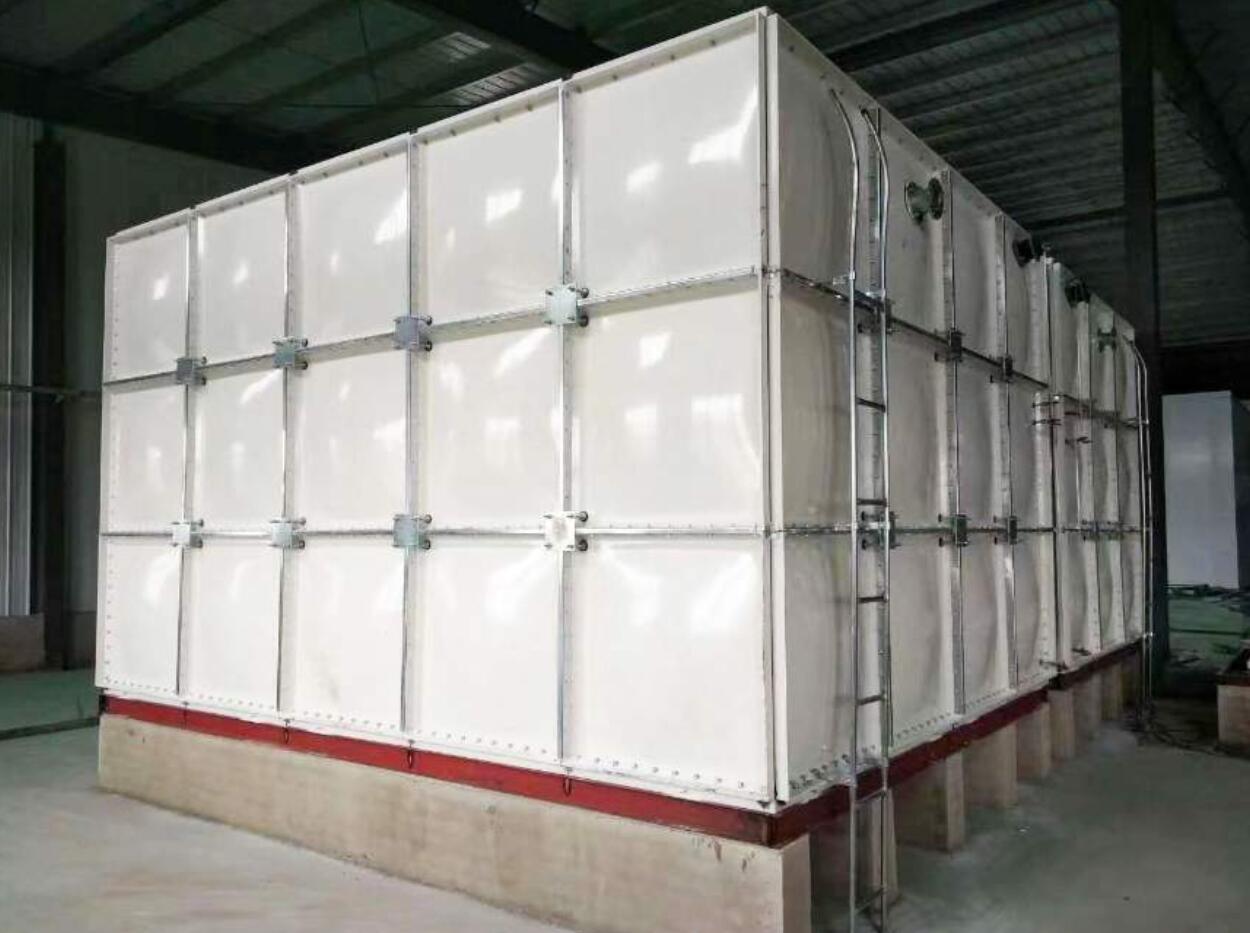
Introduction
FRP (Fiberglass Reinforced Plastic) water tanks are widely used in municipal water supply, fire storage, and industrial cooling water systems due to their light weight, high strength, corrosion resistance, and ease of installation. Beijing Yuanhui FRP Co., Ltd., established in 2008, has delivered over 30,000 sets of tanks ranging from 50m³ to 2,000m³. This article breaks down the complete production process from raw materials to finished products, comparing hand lay-up and compression molding techniques with actual production data.
1. Material Selection: Matching Resin and Fiber
1.1 Resin System
The matrix resin commonly used is 196# orthophthalic unsaturated polyester, with a viscosity of 0.25–0.45 Pa·s at 25°C and an acid value of 18–24 mgKOH/g. For outdoor applications in southern China, isophthalic or vinyl ester resins are recommended to resist UV degradation. The curing agent MEKP (methyl ethyl ketone peroxide) is added at 1.2%–2.0% of resin weight. For every 5°C drop in ambient temperature, the MEKP dosage must increase by 0.2 percentage points.
1.2 Reinforcement Specifications
Hand lay-up uses 300g/m² chopped strand mat and 0.4mm woven roving alternately. Compression molding uses 20mm chopped glass strands. Beijing Yuanhui specifies a minimum side panel thickness of 6mm and bottom panel thickness of 8mm. Resin wet-out time for each layer must be controlled between 40–60 seconds to avoid dry spots or air bubbles.
2. Hand Lay-Up Process: Layer-by-Layer Control
2.1 Mold Preparation
Mold surface roughness must be Ra≤3.2μm. Apply PMR mold release wax three times at 15-minute intervals. Over-application causes pinholes. Beijing Yuanhui requires polishing with a scouring pad after waxing, checking for runs or wax buildup visually.
2.2 Lamination Procedure
The first layer is a resin-rich layer with 75% resin content, about 0.5mm thick, to enhance impermeability. Alternate mat and roving layers, using a roller to remove air bubbles with 5–8kg pressure. Resin amount per layer is estimated as Q=G×0.65 (Q=resin weight, G=glass weight). When ambient temperature drops below 15°C, heating blankets maintain mold surface at 25±3°C.
2.3 Curing and Demolding
Room-temperature curing takes 12–24 hours, achieving ≥85% curing degree (Barcol hardness ≥35). Beijing Yuanhui uses stepped post-curing: 40°C for 2 hours → 60°C for 4 hours → natural cooling. Demold using wedge-shaped copper tools from edges; no hammering allowed.
3. Compression Molding: Efficiency and Precision
3.1 Material Preparation
Use BMC (Bulk Molding Compound) or SMC (Sheet Molding Compound) with fiber content of 28%–32%. SMC paste viscosity after thickening reaches 1×10⁶–5×10⁶ mPa·s. Beijing Yuanhui's press shop operates a 500-ton four-column hydraulic press with clamping speed of 8–12mm/s and holding pressure of 15–20MPa.
3.2 Molding Parameters
Mold temperature: upper 150±5°C, lower 145±5°C. Charge weight is 1.15 times the part volume, covering at least 70% of the cavity. Holding time is 30 seconds per mm of thickness (e.g., 180 seconds for 6mm panel). Degassing occurs 2–3 times within 5 seconds after clamping.
3.3 Flash Removal
Flash thickness after demolding must be ≤0.3mm. Cut with diamond blade and chamfer edges to R2. Molded parts require 2 hours at 80°C for stress relief, no secondary curing needed.
4. Quality Testing and Defect Solutions
4.1 Mechanical Testing
Per GB/T 1447-2005, tensile strength must be ≥80MPa, flexural strength ≥110MPa. Beijing Yuanhui tests two samples per batch. If strength is below 85% of standard, the batch is rejected and fiber content or curing process is adjusted.
4.2 Leak Test
Assembled tank is filled with water for 72 hours. Water level drop must not exceed 0.5%. Leaks are drilled to φ8mm, filled with epoxy putty, ground smooth after curing, and retested.
4.3 Common Defects
- Bubbles: ≤3mm can be filled with resin; >3mm requires excavation and patching.
- Warpage: If curvature exceeds 2mm/m, re-cure under flat clamp.
- White spots: Apply diluted resin (resin:acetone=10:1) to under-wetted fibers.
Conclusion
FRP water tank production is shifting from pure hand lay-up to compression molding and RTM (Resin Transfer Molding). Beijing Yuanhui FRP Co., Ltd.'s experience shows hand lay-up remains cost-effective for custom shapes and large tanks, while compression molding boosts efficiency by over 300% for standardized parts. For SMEs, establishing documented process parameters (temperature, pressure, layer thickness) is critical for consistent quality and ISO 9001 certification.