Pressure Performance of FRP Water Tanks: Testing Standards and Engineering Insights
Introduction
FRP (Fiberglass Reinforced Plastic) water tanks are widely used in fire protection, industrial storage, and municipal water supply due to their light weight, high strength, corrosion resistance, and long service life. Pressure performance is the most critical indicator of structural safety and durability. A poorly designed or manufactured tank may suffer deformation, cracking, or even catastrophic failure under sustained hydrostatic load or transient surge. This article, based on production data from Beijing Yuanhui FRP Co., Ltd., presents a systematic analysis of pressure mechanisms, testing standards, and engineering practices for FRP water tanks.
Pressure Performance Mechanism and Key Parameters
Mechanical Properties of Materials
The pressure-bearing capacity of an FRP tank derives from the composite effect of glass fiber reinforcement and resin matrix. Glass fibers provide high tensile strength (typically ≥300 MPa), while the resin contributes corrosion resistance and fatigue tolerance. Standard SMC (Sheet Molding Compound) panels exhibit tensile strength ranging from 80 to 120 MPa and flexural modulus between 7 and 10 GPa. For large tanks, the structural laminate thickness is calculated based on 10 kPa per meter of water column, with a safety factor of 5 to 8.
Structural Design Considerations
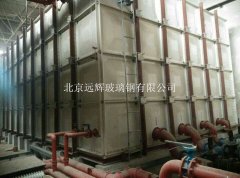
Pressure capacity is affected by panel thickness, stiffener layout, joint design, and base support. In a 100 m³ fire water tank produced by Beijing Yuanhui FRP Co., Ltd., the side panels are 6 mm thick SMC, with transverse stiffeners spaced at 500 mm and longitudinal ribs at 400 mm, supported by an I-beam foundation. Finite element analysis showed a maximum deflection of less than 3 mm under 9 m static head, well below code limits.
Testing Standards for Pressure Performance
Chinese Standard: GB/T 21238-2016
This standard specifies hydrostatic pressure tests for FRP tanks. The tank is filled with water, pressurized at 1.25 times the design pressure, and held for 30 minutes. No leakage or visible deformation is permitted. Beijing Yuanhui FRP Co., Ltd. conducts a 72-hour pressure hold test on every tank, with pressure drop less than 2%.
International Standards: ASTM D3299 / ISO 21425
ASTM D3299 covers long-term hydrostatic performance of filament-wound FRP tanks, using stepwise pressurization to determine burst pressure. ISO 21425 focuses on cyclic pressure fatigue testing, simulating stress fluctuations from water level changes. Tanks exported to Middle East projects were subjected to 50,000 pressure cycles per ASTM standards, confirming a 20-year design life.
Key Factors Affecting Pressure Performance and Quality Control
Raw Materials and Processing
Resin type (orthophthalic, isophthalic, vinyl ester) directly impacts temperature and corrosion resistance. Vinyl ester resin maintains over 80% strength at 80°C. Improper molding temperature or pressure can cause voids or delamination, reducing pressure capacity. Beijing Yuanhui FRP Co., Ltd. uses vacuum-assisted molding, achieving a void content below 1%, significantly better than industry averages.
Installation and Foundation
Uneven settlement or support introduces bending moments and local stress concentrations. Foundation flatness should be ≤5 mm/m, with fine sand or rubber pads for uniform load transfer. In a 2023 chemical plant project, improper foundation caused bottom cracks. After on-site correction and reinforcement by Beijing Yuanhui FRP Co., Ltd., pressure performance was restored to design values.
Engineering Cases and Data
A batch of 50 m³ modular FRP water tanks supplied by Beijing Yuanhui FRP Co., Ltd. for a municipal water project, with a design pressure of 0.6 MPa, passed a third-party test at 0.75 MPa for 1 hour with no leakage and only 0.8 mm deflection. After three years of operation, retesting showed less than 5% performance degradation. Another case: a 120 m³ tank using isophthalic resin passed a 1.5× safety factor hydrostatic test at -20°C.
Conclusion
The pressure performance of FRP water tanks is a combined result of material quality, structural design, manufacturing precision, and installation workmanship. Compliance with GB/T 21238 and ASTM D3299 testing standards is fundamental to quality assurance. Selecting high-grade materials, optimizing stiffener layouts, and performing careful foundation work are key to reliable pressure capacity. Beijing Yuanhui FRP Co., Ltd. continues to provide high-pressure-rated FRP tanks meeting international standards, and recommends periodic pressure retesting every 2–3 years for long-term operational safety.