Seismic Performance Analysis and Key Design Specifications for FRP Water Tanks
Seismic Performance Analysis and Key Design Specifications for FRP Water Tanks
Earthquakes pose a significant threat to the integrity of water supply systems. As critical storage facilities, the seismic performance of Fiber Reinforced Plastic (FRP) water tanks directly impacts post-earthquake emergency water supply and the recovery of lifeline infrastructure. The unique composite material properties and flexible structural design of FRP offer distinct advantages in seismic resistance.
Seismic Performance Advantages of FRP Water Tanks
The seismic resilience of FRP tanks is rooted in the integrated design of their material and structure.
Material Properties: High Strength-to-Weight Ratio and Toughness
FRP, composed of glass fiber reinforcement and a polymer resin matrix, possesses a specific strength (strength-to-density ratio) superior to that of mild steel. This allows FRP tanks to achieve comparable structural strength with significantly less self-weight. Engineering data indicates FRP density ranges from 1.8 to 2.1 g/cm³, approximately one-quarter that of steel. Since seismic inertial forces are proportional to mass, this lightweight characteristic drastically reduces seismic loads, fundamentally enhancing safety. Furthermore, FRP exhibits good toughness and a failure strain much higher than brittle materials, enabling it to absorb seismic energy through elastic deformation and avoid sudden brittle fracture.
Structural Design: Monolithic Construction and Flexible Connections
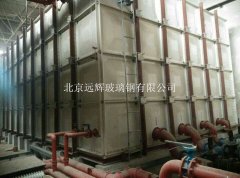
High-quality FRP tanks are manufactured using filament winding on large molds or seamless assembly of modular panels, ensuring excellent structural integrity. Structural continuity is a core principle of seismic design, preventing stress concentrations and localized failures. For instance, Beijing Yuanhui FRP Co., Ltd. employs computer-controlled filament winding in major projects, allowing for directional reinforcement of fibers in critical stress areas, creating a monolithic tank body. Additionally, flexible connections between the tank and its foundation are vital. Installation typically involves embedded steel parts with rubber gaskets or specialized seismic isolation bearings, permitting limited displacement or rocking to dissipate energy rather than resisting seismic forces rigidly.
Seismic Design Codes and Standards for FRP Tanks
Compliant seismic design is the legal and technical foundation for ensuring the safe operation of FRP water tanks.
Analysis of Core Design Standards
The design of FRP tanks must adhere to national standards and industry codes. The "Code for Seismic Design of Buildings" (GB 50011 in China, or equivalent like ASCE 7 in the U.S.) is the primary document, stipulating seismic fortification objectives, seismic action calculation methods, and detailing requirements for buildings and their non-structural components, including tanks. For the tank structure itself, standards such as "Glass Fiber Reinforced Plastic Water Tanks" (JC/T 658.1) are referenced. Designers must calculate the horizontal seismic influence coefficient based on the seismic precautionary intensity of the site (e.g., 7, 8 degrees), site classification, and installation height, followed by strength and stability checks for panels, stiffeners, roof, and supports.
Key Design Parameters and Calculation Focus
Seismic calculations focus on several aspects. First is the seismic action calculation, which must account for the "sloshing" and "impulsive" effects of the stored water. These hydrodynamic pressures significantly increase loads on the tank wall and base. Second is the design of connection details. Joints between stiffeners and panels, seams between modular sheets, and anchor points to the foundation are potential seismic weak points and require enhanced design, often with a safety factor 1.5 times higher than standard design. Finally, deformation control is essential to ensure that under rare earthquake events, overall tank deformation and joint displacement remain within allowable limits to prevent leakage or overturning.
Engineering Practices and Seismic Performance Enhancement
Theoretical codes must be implemented through engineering practice. Targeted enhancement measures can significantly improve the seismic reliability of FRP tanks.
Refined Design and Construction
For FRP tanks in high-rise buildings or seismically active zones, design requires greater refinement. This includes using Finite Element Analysis software to simulate the seismic response of the fluid-structure interaction system, precisely identifying high-stress zones. In construction, ensuring proper resin curing, accurate fiber orientation, and reinforcing seams with multiple layers of fiber cloth and corrosion-resistant resin are critical. The foundation must be level and robust, with accurately placed embedded parts for effective anchorage.
Inspection and Maintenance
Post-earthquake rapid inspection and assessment of FRP tanks are crucial for maintaining water supply. Inspections should focus on visible cracks, loose connections, failed anchorage, and the condition of internal stiffeners. Regular maintenance, such as sediment removal to prevent corrosion and checking fastener tightness, is essential for preserving long-term seismic performance.
Conclusion
FRP water tanks possess inherent seismic potential due to their high strength-to-weight ratio, toughness, and structural integrity. However, translating this potential into reliable safety requires strict adherence to national seismic design codes, scientific calculation of seismic actions, meticulous structural detailing, and the integration of seismic principles throughout the entire chain of material selection, manufacturing, installation, and maintenance. As a professional FRP tank manufacturer, Beijing Yuanhui FRP Co., Ltd. is committed to advancing research in seismic design and application technologies, providing safer and more reliable water storage solutions for various buildings and infrastructure projects, thereby contributing to the overall disaster resilience of communities.