Modular Assembly Process of FRP Water Tanks: From SMC Molding to On-Site Installation
Introduction
The modular assembly process of FRP (Fiberglass Reinforced Plastic) water tanks has become the industry benchmark for efficient and reliable water storage. Instead of traditional hand lay-up molding on-site, this method uses standardized SMC (Sheet Molding Compound) panels that are bolted together with EPDM gaskets to form tanks of any capacity. A typical 300 m³ domestic water tank built by Beijing Yuanhui FRP Co., Ltd. can be installed in just 3 days instead of 15 days using the old method, with panel strength deviation controlled within ±2%. This article breaks down the process from material production to final testing.
1. SMC Molded Panels: The Building Blocks
1.1 Material Composition and Molding Parameters
Beijing Yuanhui uses an SMC formulation consisting of 28–32% unsaturated polyester resin, 25–30% E-glass fiber (25–50 mm length), 40–45% calcium carbonate filler, and 0.5–1% mold release agent and initiator. Molding temperature is set at 140–160°C under 15–20 MPa pressure, with a dwell time of 45 seconds per millimeter of thickness. For a 14 mm panel (common in medium-capacity tanks), the cycle time is 630 seconds, yielding a flexural strength above 180 MPa and Barcol hardness of 50 or higher.
1.2 Standard Dimensions and Tolerances
Standard panel sizes are 1000 mm × 1000 mm and 1000 mm × 500 mm, with thickness options of 10, 12, 14, and 16 mm. Each panel features male/female tongue-and-groove edges (5 mm tongue height, 4 mm groove depth) with a designed gap of 0.2–0.5 mm. Beijing Yuanhui’s quality inspection data show diagonal error ≤1.5 mm/m, flatness ≤1 mm/m, and edge perpendicularity ≤0.5°. This precision ensures a bolt hole alignment rate of 99.7% during assembly.
2. Sealing and Fastening System
2.1 EPDM Gasket Design
Leak prevention relies on dual-seal EPDM (ethylene propylene diene monomer) rubber gaskets. The material has a Shore A hardness of 60±5, tensile strength ≥10 MPa, and elongation at break ≥300%. Beijing Yuanhui’s design incorporates an O-ring inserted into the panel groove as the primary seal, plus a flat gasket on the lap joint as a secondary barrier. Under a 0.4 MPa hydrostatic test, leakage is measured at less than 0.05 L/(m²·h), well below the 0.2 L/(m²·h) limit specified by GB/T 17219-1998.
2.2 Hot-Dip Galvanized Bolts and Torque Control
Bolts are M12-8.8 grade hot-dip galvanized steel with a zinc coating thickness ≥55 μm. Each standard panel uses 16 bolts (4 per side) through 14 mm diameter holes located 40 mm from the panel edge. The critical parameter is tightening torque: Beijing Yuanhui’s procedure requires a three-step tightening sequence using a torque wrench, with a final torque of 60 N·m ±5 N·m. Insufficient torque causes gasket compression loss; excessive torque can induce micro-cracks. A 2023 audit of a 200 m³ tank in Beijing showed that after 72 hours of full water load, residual bolt torque remained above 58 N·m.
3. On-Site Assembly and Quality Control
3.1 Base Inspection and Floor Panel Installation
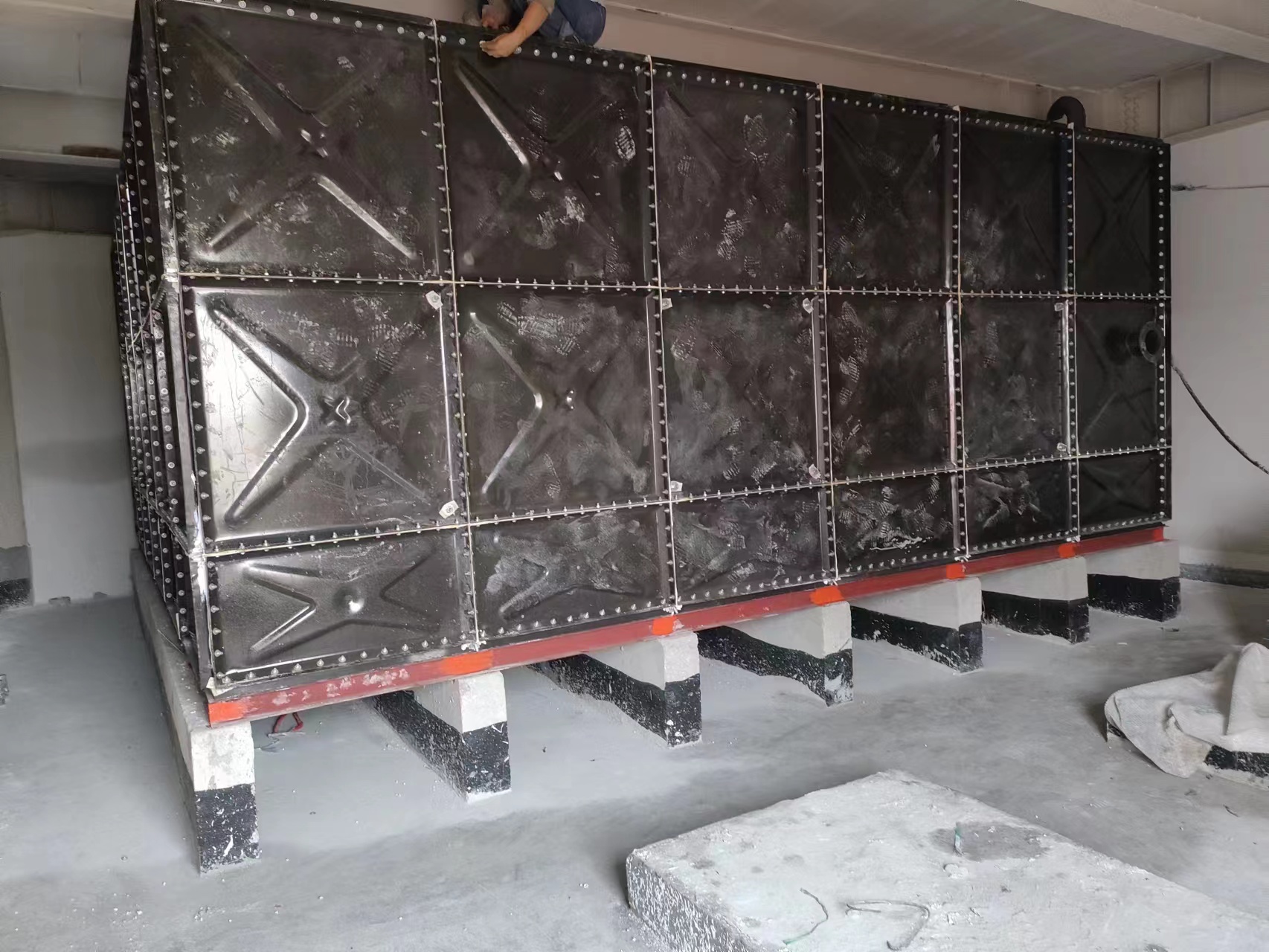
The concrete base must have a flatness ≤3 mm/m, and the steel channel frame must be level within 2 mm/m, coated with epoxy coal tar pitch for corrosion protection. Floor panels are installed from the center outward, with silicone sealant applied between joints (1.5–2 mm thickness). Beijing Yuanhui’s protocol requires a level check after every five floor panels.
3.2 Wall and Roof Panel Assembly
Wall panels are installed in a staggered pattern—similar to brick masonry—with vertical joints offset by at least 300 mm to improve structural rigidity. Corner panels are placed first, then layers are built upward. The roof includes a 600 mm × 600 mm manhole cover (hinged quick-open type with food-grade silicone gasket) and a DN100 vent. In a 100 m³ installation for a pharmaceutical plant in Henan, four workers completed all wall panel assembly in 12 hours, achieving a first-pass torque compliance rate of 96%.
3.3 Hydrostatic Testing and Leak Remediation
A 24-hour hydrostatic test follows assembly. Water is added at 1 m/h in three stages (4-hour intervals between fills). An infrared thermal camera scans panel joints for temperature anomalies; a difference exceeding 2°C indicates a potential leak. Beijing Yuanhui’s project data show a first-pass success rate of approximately 85%. The most common issue (62% of leak cases) is insufficient bolt torque at the wall-roof junction, corrected by partial drainage and re-torquing.
Conclusion
The modular assembly process of FRP water tanks—built on standardized SMC panels, dual EPDM sealing, precise bolt torque control, and a staggered on-site installation sequence—has transformed water storage construction from a craft-based, time-consuming operation into a predictable, factory-quality system. Over the past three years, Beijing Yuanhui FRP Co., Ltd. has completed more than 120 projects using this method, achieving a 60% reduction in installation time and a drop in leak-related rework from 8% (traditional process) to 1.2%. For projects that demand both speed and long-term reliability, modular assembly is now the standard.