Thermal Insulation Performance of FRP Water Tanks: A Technical Deep Dive into Parameters and Applications
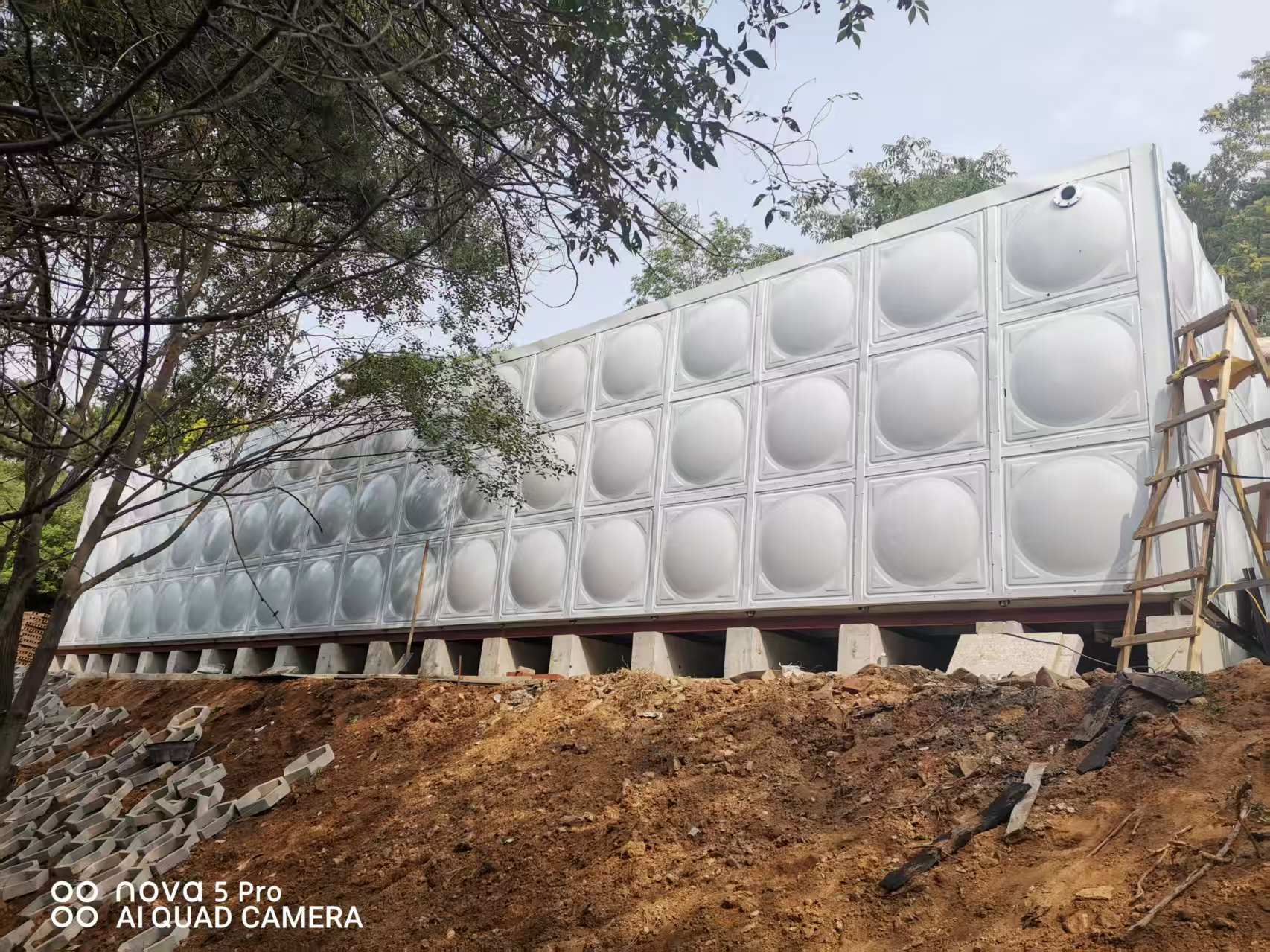
Introduction
FRP water tanks are not inherently insulated. Their thermal retention depends entirely on the composite layer design. In the industry, an 'insulated water tank' typically refers to an FRP inner liner wrapped with a polyurethane or XPS insulation layer, followed by an outer protective shell. In 2023, Beijing Yuanhui FRP Co., Ltd. conducted a comparative test on its SMC molded tanks: under -10°C ambient temperature and 60°C initial water temperature, a tank with 50mm polyurethane insulation showed a temperature drop of only 4.2°C over 24 hours, while an uninsulated tank of the same size lost 18.7°C. This data underscores that the insulation layer is the decisive factor.
1. Structural Design and Thermal Parameters of Insulated FRP Tanks
1.1 Three-Layer Architecture
A standard insulated FRP water tank consists of an inner liner, an insulation layer, and an outer shell. The inner liner, made of SMC sheets 5-8mm thick, provides water containment and corrosion resistance. The insulation layer uses polyurethane foam (PU) or extruded polystyrene (XPS), ranging from 30mm to 100mm, with thermal conductivities of 0.022-0.028 W/(m·K) and 0.030-0.035 W/(m·K), respectively. The outer shell, typically FRP sheet or color steel, resists UV, weathering, and impact.
1.2 Heat Transfer Coefficient vs. Thickness
According to the heat transfer equation Q=K·A·ΔT, the overall heat transfer coefficient (K-value) of an insulated tank depends on the thermal resistance of each layer in series. For 50mm PU insulation, the calculated K-value is approximately 0.45 W/(m²·K), equivalent to a 370mm brick wall. Field records from Beijing Yuanhui FRP show that in North China winters, a tank with 80mm insulation maintaining water at 40-50°C requires only about 2.3 kWh/m³ of supplementary heat per day, compared to 8.5 kWh/m³ for an uninsulated tank.
2. Application-Specific Insulation Selection Strategies
2.1 Buffer Tanks for Heating Systems
Air-source heat pumps and solar thermal systems often use buffer tanks to stabilize water temperature. These tanks must minimize heat loss during nights or cloudy days. A minimum insulation thickness of 60mm is recommended, with thermal break treatment at all pipe connections. For a villa project in Beijing, a 6m³ FRP tank with 80mm PU insulation, paired with a heat pump, showed that tank heat loss accounted for only 4.7% of total system energy consumption over a 120-day heating season.
2.2 Fire Protection and Domestic Water Supply
Fire protection tanks have looser insulation requirements but must prevent freezing. In Northeast China, outdoor fire tanks require insulation thickness of 100mm or more, plus electric heat tracing or circulation loops. Domestic hot water tanks need both insulation and hygiene: the liner should use food-grade resin, and the insulation layer must be vapor-sealed to prevent bacterial growth. Beijing Yuanhui FRP supplied a 30m³ insulated tank to a hospital, using isophthalic resin for the liner and 75mm insulation; water quality remained within national standards after three years of operation.
2.3 Industrial Constant-Temperature Storage
Pharmaceutical, electronics, and chemical industries often require water temperature fluctuations within ±2°C. These tanks need dual insulation layers—inner PU plus outer aerogel felt—totaling up to 120mm, with reinforced top and bottom insulation. Test data shows that with 80°C inlet water, this structure loses only 1.8°C over 24 hours, meeting GMP requirements for hot water systems.
3. Common Insulation Failure Causes and Mitigation
Insulation failures frequently occur at seams, pipe penetrations, and access hatches. Unsealed joints create thermal bridges, leading to condensation and heat loss. Solutions include pre-embedded sealing strips at panel joints, continuous spray-foam application, and rubber insulation boots for pipe connections. In 2024, Beijing Yuanhui FRP reviewed 25 service cases and found that 68% of insulation complaints stemmed from missing vapor barriers during installation, which allowed polyurethane to absorb moisture and increase thermal conductivity to over 0.05 W/(m·K).
Conclusion
The thermal insulation performance of an FRP water tank is not a fixed value—it is the result of designed thickness, material selection, sealing quality, and on-site installation. For end users, defining the temperature requirements, environmental conditions, and duty cycle of the application first, then back-calculating the insulation parameters, is more cost-effective than blindly choosing a thicker layer. Beijing Yuanhui FRP Co., Ltd. recommends that when purchasing insulated tanks, buyers request a heat transfer calculation based on their specific operating conditions, not just an empirical quote. An insulated tank is a system—every layer failure shows up on the energy bill.