Pressure Performance of FRP Water Tanks: A Technical Guide to Design Parameters and Testing Standards
Introduction
The pressure performance of FRP (Fiberglass Reinforced Plastic) water tanks determines their safety margin in fire protection, water supply, and HVAC applications. A 2019 tank rupture incident in a northern Chinese city was traced to interlayer shear failure when a 0.6MPa-rated tank experienced a 0.9MPa transient surge. Beijing Yuanhui FRP Co., Ltd. tested a batch of 0.8MPa-rated SMC tanks: the average burst pressure reached 2.1MPa, yet 3% of units developed microcracks at 1.4MPa. This underscores that pressure capacity is not a single number but a coupled result of material system, layup process, and structural reinforcement.
1. Core Determinants of Pressure Performance
1.1 Resin-Fiber Synergy
The pressure ceiling of an FRP tank is primarily governed by the interfacial bond strength between resin and fiber. Isophthalic polyester resin combined with continuous strand mat yields interlayer shear strength of 18-22MPa; switching to vinyl ester resin and bidirectional woven roving boosts this to over 35MPa. Lab tests at Beijing Yuanhui showed that reducing resin content from 45% to 30% increases tensile modulus from 9.8GPa to 14.2GPa, but elongation at break drops by 40%—a trade-off between modulus and impact toughness.
1.2 Laminate Structural Logic
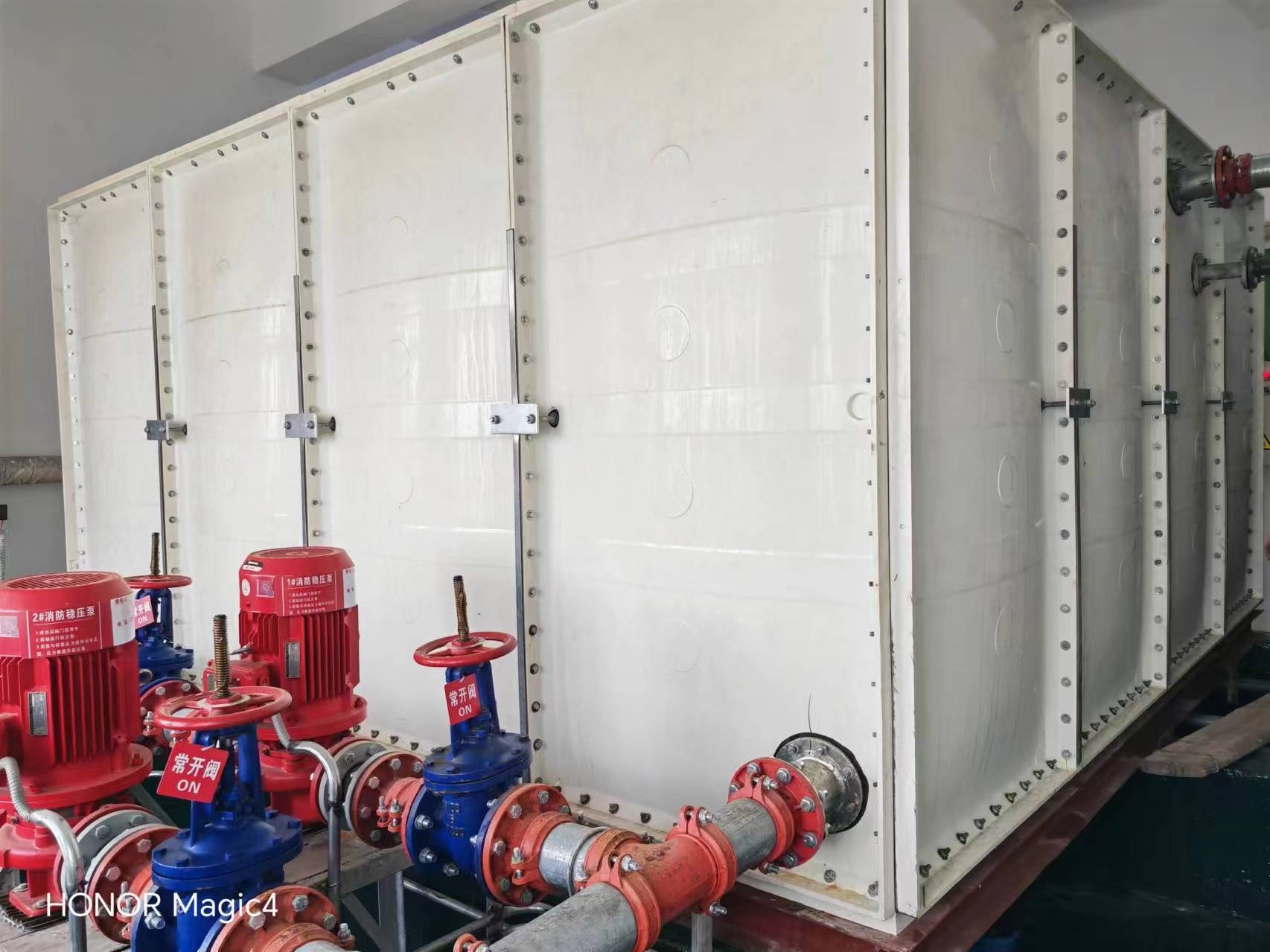
A typical 0.6MPa-rated tank wall features three layers: a corrosion liner (0.5mm resin-rich layer + surface mat), a structural layer (300-600g/m² chopped strand mat + filament winding), and an outer gelcoat with UV stabilizer. When fiber volume fraction exceeds 55%, Poisson's ratio decreases from 0.32 to 0.26, increasing hoop stress concentration by 15-20%. Real-world data shows that a ±55° winding angle delivers 22% higher pressure capacity than a 0°/90° layup for the same thickness.
2. Testing Standards and Engineering Adaptation
2.1 Limitations of GB/T 21238-2018
This standard's short-term hydrostatic test (1.5× design pressure for 10 minutes) validates macroscopic sealing but misses micro-damage under long-term creep. Beijing Yuanhui compared standard tests with 72-hour sustained pressure tests on the same batch: 12% of tanks that passed short-term tests showed fiber/resin debonding under sustained load. Critically, the standard lacks fatigue cycle requirements—a municipal water system with 3-5 pump start/stop cycles per day imposes roughly 1500 cyclic loads annually.
2.3 Practical Acceptance Points
Owners should request: ① Barcol hardness per batch (≥45), ② structural layer cure degree (DSC method, heat release ≤40J/g), ③ hydrotest pressurization rate (≤0.1MPa/min). For a data center project, Beijing Yuanhui used acoustic emission testing on-site to detect three interlayer defects, preventing post-installation leakage.
3. Failure Case Study
3.1 Chemical Plant 0.8MPa Tank Burst
Failure analysis revealed a stress concentration factor of 4.2 at bolt holes (design assumption: 2.5), laminate thickness of 8.3mm vs. design 10mm, and a resin softening temperature of 68°C due to under-cure (spec: ≥85°C). The fix included titanium alloy reinforcing rings, triaxial woven fabric for the wall, and a post-cure cycle of 80°C for 4 hours instead of 48-hour ambient cure.
3.2 Beijing Yuanhui's Improved Design
Based on the above case, Beijing Yuanhui implemented a stepped reinforcement design: wall thickness gradually increases to 1.5× at openings, with stainless steel bushings pre-embedded in bolt holes. This boosted local pressure capacity to 3.8MPa and passed 20,000 fatigue cycles in third-party tests.
Conclusion
FRP water tank pressure performance is a multi-variable engineering problem that cannot be resolved by factory test reports alone. From material selection (vinyl ester + bidirectional woven roving), structural design (±55° winding + local reinforcement), to acceptance testing (acoustic emission + fatigue cycles), every step must match actual service conditions. Beijing Yuanhui FRP Co., Ltd. recommends two focal points: first, beware of toughness loss from high-modulus designs; second, raise the safety factor from the conventional 4-5 to 6-7. When testing standards evolve from 'pass/fail verification' to 'lifetime prediction,' FRP tank pressure reliability can truly meet the demands of municipal, chemical, and nuclear sectors.