Pressure Bearing Performance of FRP Water Tanks: Testing Standards and Engineering Applications
Introduction
FRP water tanks are widely used in construction, municipal, and industrial water storage due to their light weight, high strength, and corrosion resistance. However, pressure bearing capacity is the critical factor determining safety and longevity. Beijing Yuanhui FRP Co., Ltd. has accumulated extensive testing data over years of production. This article examines material mechanics, structural design, testing standards, and real-world engineering cases.
1. Pressure Bearing Mechanism and Key Factors
1.1 Material Level: Fiber Layup and Resin Matrix Synergy
The composite performance of glass fiber (30%–50% by weight) and resin (polyester, epoxy, or vinyl ester) dictates tank strength. With spray-up or hand lay-up processes, inter-laminar shear strength (ILSS) above 12 MPa prevents delamination under 0.6 MPa hydrostatic pressure, as verified in Beijing Yuanhui's 10m³ standard tank tests.
1.2 Structural Design: Stiffeners and Variable Wall Thickness
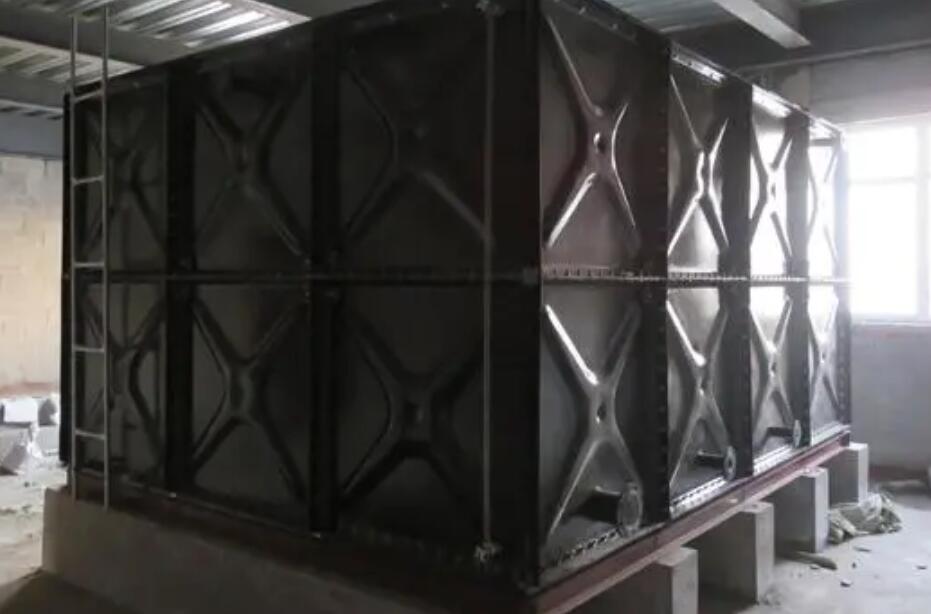
For large rectangular tanks (panel area >6m²), Beijing Yuanhui employs trapezoidal stiffeners and graded wall thickness—bottom walls 20%–30% thicker than top walls. Finite element analysis (FEA) shows that at 1.0 MPa design pressure, maximum deformation stays below 3 mm, well within the 5 mm limit of GB/T 3216-2016.
2. Comparison of International Testing Standards
2.1 Chinese Standard: GB/T 3216-2016
This standard mandates hydrostatic pressure tests at 1.5× design pressure for 30 minutes (no leakage or visible deformation) and cyclic pressure tests (0 to design pressure, 1000 cycles) for fatigue validation. In 2023, Beijing Yuanhui passed type inspection on three 12m³ units at 1.2 MPa test pressure (0.8 MPa design), with residual deformation of only 0.8 mm.
2.2 International Standards: ASTM D2583-07 and ISO 13927
ASTM D2583 uses Barcol hardness (≥40 for general-purpose resins) as an indirect strength indicator. ISO 13927 focuses on long-term hydrostatic strength (LTHS) via 10,000-hour extrapolation. Tanks meeting GB/T 3216 typically show LTHS values of 80–100 MPa, sufficient for most civil and light industrial applications.
3. Engineering Cases and Measured Data
3.1 Case: Secondary Water Supply in High-Rise Building
A 32-story Beijing residence installed a 30m³ modular FRP tank (design pressure 1.0 MPa) from Beijing Yuanhui. During full-water testing (1.2 MPa static), strain gauges recorded a maximum hoop strain of 1200 με on the bottom and 850 με on sidewalls—both within elastic limits. After two years of operation, no performance degradation was observed.
3.2 Data: Burst Pressure vs. Wall Thickness
Burst tests on DN2000 circular tank samples: 6mm wall → 1.8 MPa burst; 8mm → 2.4 MPa; 10mm → 3.1 MPa. The linear correlation (R²=0.998) confirms that optimized layering is more cost-effective than simply increasing thickness beyond 10mm.
Conclusion
FRP tank pressure performance depends on material, design, and manufacturing quality. GB/T 3216 aligns with international standards, but cyclic loading and long-term creep must be considered in engineering. Beijing Yuanhui FRP Co., Ltd. recommends selecting suppliers who provide type inspection reports (static, cyclic, and burst data) and have FEA capability and online Barcol hardness testing. With future carbon-fiber hybrid technologies, FRP tanks may exceed 5.0 MPa, opening new applications in high-pressure firefighting and industrial storage.